
Item quality: the roll you can pay to retake
What Albion Online item quality actually does
Albion Online item quality is the second price ladder hiding inside every piece of gear. Each crafted item rolls one of five qualities, Normal, Good, Outstanding, Excellent, Masterpiece, and a higher quality means more item power on the same item: an Outstanding sword hits harder than its Normal twin without changing tier, enchant or recipe. The market takes that seriously enough to price every quality tier separately. An Outstanding piece is its own listing, often at a real premium over Normal; Excellent and Masterpiece climb higher still.
Most players meet quality as pure luck: craft, look at the roll, shrug. But quality is also a market: and any time the same item trades at five different prices, there is a question worth silver: what is the cheapest way to end up holding the expensive version?
Where quality comes from: and how to retake the roll
Quality is assigned at craft time by a random roll. Crafting specialization improves the distribution, a deep spec line lands the good rolls more often: but no amount of spec makes the outcome certain. What most players never touch is the second lever: quality can be rerolled after the fact. Pay the artificer a silver fee and the piece rolls a fresh quality. The fee scales with the item's value: each reroll costs item value × 3.975 × a quality multiplier: so rerolling a cheap piece is cheap and rerolling an expensive one stings.
That one mechanic changes the whole question. A Normal roll is no longer a consolation prize; it's a raw ingredient. Craft at Normal, pay for rerolls, and you're manufacturing shots at Outstanding, which is only a good deal if the market's premium for Outstanding exceeds what those shots cost.
Four roads to a target quality
Say the target is an Outstanding T6 sword. There are four ways to end up holding one:
Roll it. Craft and hope, spec-weighted luck, free beyond the craft itself. Reroll it. Craft (or buy) at Normal and pay reroll fees until the roll lands Outstanding or better. Buy it. Pay the market's premium for an already-Outstanding listing and skip the dice entirely. Route through enchanting. Because the reroll fee scales with item value, rerolling a piece at a lower enchant level: where its value, and therefore the fee, is smaller, and enchanting up afterwards can undercut every direct road. Quality rerolling and enchanting up are the game's two "same item, better version" mechanics, and they compound.
Each road has a cost. The reroll road's cost is an expected one, because the roll is random: solving the community-measured reroll odds for the expected total spend to reach at least a target quality from Normal gives about ×1.00 of the base fee for Good, ×2.43 for Outstanding, and ×4.94 for Excellent. Which road is cheapest is not a fact about the game, it's a fact about today's prices, and it flips item by item as the quality premium and the underlying markets move.
One road is deliberately missing: Masterpiece is not a target. At community-measured odds of roughly 0.1-0.5% per roll, the expected cost of chasing it dwarfs any premium the market pays. A Masterpiece that lands while you're rolling toward Excellent is a windfall; planning for one is buying lottery tickets with extra steps.
The discipline: thin markets and expected values
Two honesty checks keep this trade from becoming a donation. First, per-quality markets are thin. Outstanding and Excellent listings trade far less often than Normal ones, so their prices age fast: the Excellent price you're comparing against may belong to last week. Any road-versus-road comparison is only as good as its stalest number, which is why every path deserves its own visible data age and confidence before silver moves.
Second, expected value is a statement about repetition. Rerolling one sword is a slot machine; rerolling every sword you craft is a strategy. The ×2.43 expectation for Outstanding means some sessions cost half that and some cost double, the math only pays the player who runs it across enough pieces for the luck to average out.
Doing it without spreadsheets
Pricing four roads times several target qualities, per item, against live listings is exactly the arithmetic that automates. With Quality Reroll switched on, Profit Forge runs the expected-value math on every gear row: craft or buy at the target quality directly, craft at Normal and reroll up, and: with Enchant-Up Comparison also on: the lower-enchant detours, each priced from real listings with your return rate, fees and sales tax applied. One row per item, badged with the winning path × quality combination; the runner-up stays visible as an aligned ↳ sub-row with its own profit, cost, data age and confidence.
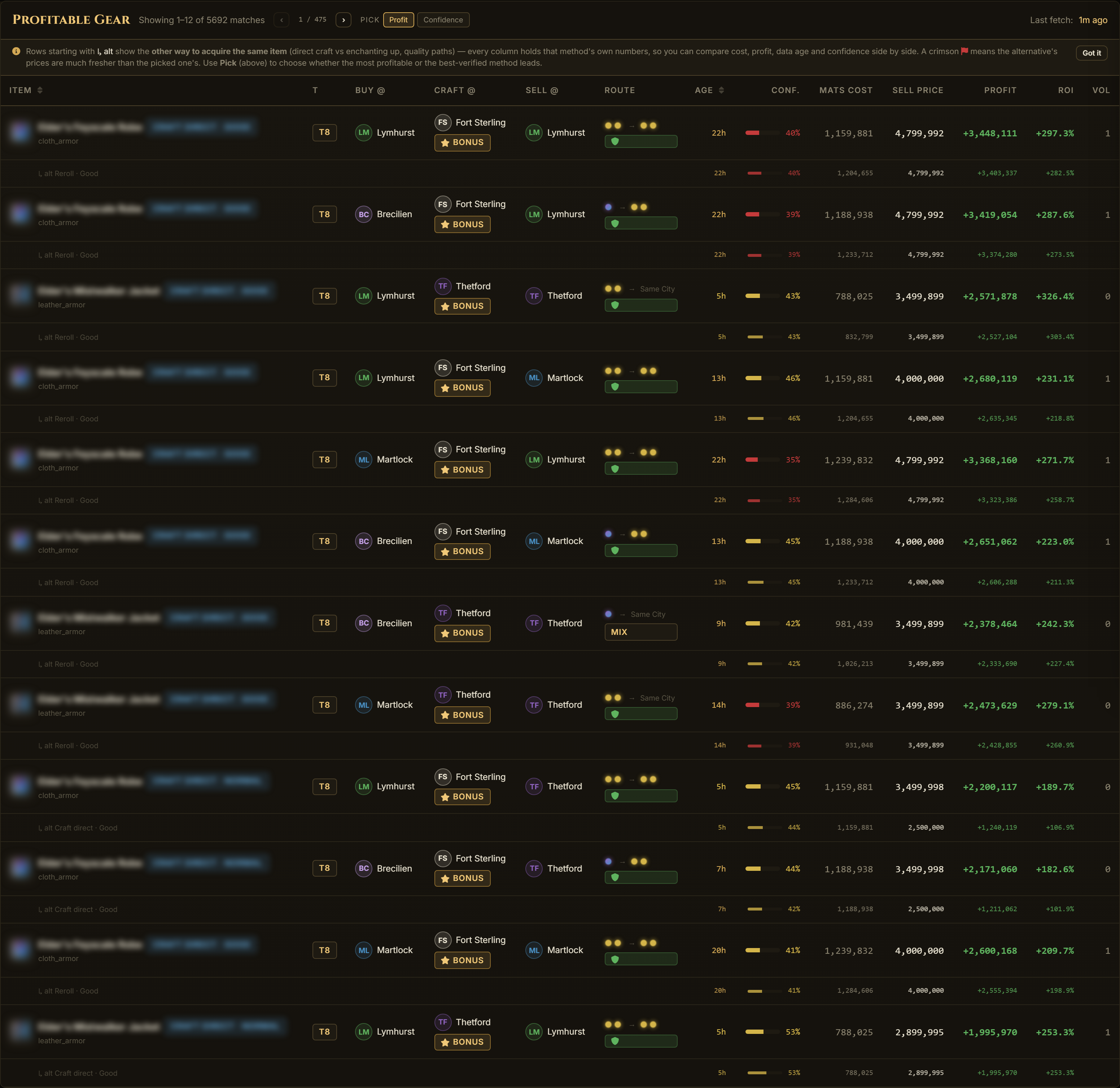
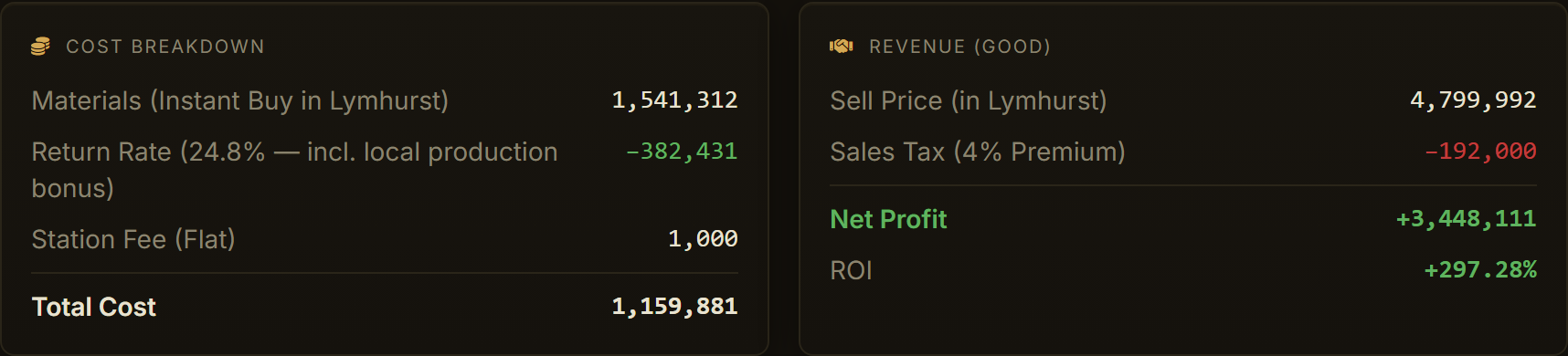
Open any row and the combo comparison lays out the winning road's full cost breakdown: and every other viable combination beside it, so a collapsed premium or a spiked reroll fee shows up as numbers, not vibes. When the market flips, the badge flips with it. That's not noise; that's the method working.
FAQ
What does item quality do in Albion Online?
Every crafted piece rolls one of five qualities: Normal, Good, Outstanding, Excellent, Masterpiece. Higher quality means more item power on the same item, and the market lists each quality tier separately, so an Outstanding piece is its own listing at its own price.
Is it worth rerolling item quality?
Only when the market's quality premium exceeds the expected reroll cost for that item: and that comparison flips as prices move. When the premium is fat, rerolling cheap Normals prints silver; when it collapses, buying the finished quality outright is cheaper. Check live prices for the specific item before spending.
How much does a quality reroll cost?
Each reroll costs the item's value × 3.975 × a quality multiplier, and the outcome is random. Using community-measured odds, the expected total cost to reach at least a target quality from Normal works out to about ×1.00 of the base fee for Good, ×2.43 for Outstanding, and ×4.94 for Excellent, an expectation, not a guarantee.
Can you reroll to Masterpiece?
Any reroll can land Masterpiece, but at community-measured odds of roughly 0.1-0.5% per roll it is a lottery ticket, not a plan, the expected cost of chasing it dwarfs any premium. Treat a Masterpiece that lands on the way to a saner target as a bonus, never as the strategy.
Does quality affect price in Albion Online?
Yes: each quality tier trades as its own listing, and Outstanding often carries a real premium over Normal, with Excellent and Masterpiece higher still. The premium varies wildly by item and city because demand targets specific qualities while supply comes from random rolls.