
What to craft in Albion Online, answered with math
What "profitable crafting" actually means
Ask city chat what to craft in Albion Online and you'll get item names: "T6.1 bloodletters", "flat T8 bags". Those answers expire the moment they're typed. The real answer isn't an item, it's an inequality: a craft is worth doing when what the finished piece sells for, after tax, beats what the materials, the station fee and the craft itself actually cost you. A crafting calculator: whether it's your spreadsheet or someone's app, exists to measure both sides of that inequality honestly, because the market quietly punishes everyone who guesses.
The loop itself is simple. Buy refined materials: metal bars, leather, cloth, planks: in a city. Craft the piece at that gear line's station. Sell it on a royal city market, or to the Black Market in Caerleon. Every step has a number attached, and two of those numbers are misread so often that they decide who profits and who merely stays busy.
The return rate: the biggest lever, and the most misread
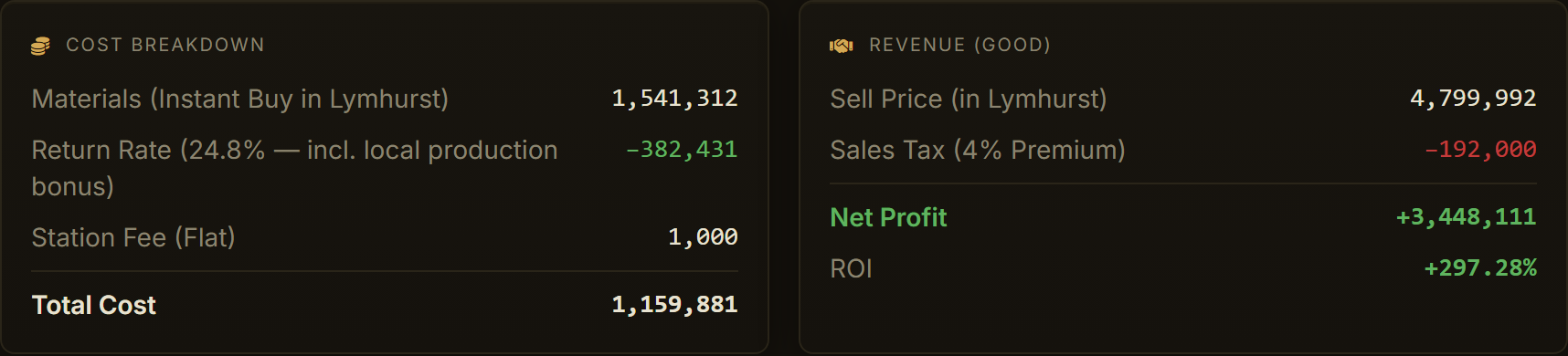
The first misread number is material cost. It is not what you paid at the market: a portion of your materials comes back on every craft, so your real cost is materials minus your crafting return rate. And that rate moves: roughly 15% comes back crafting in a royal city, around 24% where the city grants its production bonus: every city favors specific lines, swords in Lymhurst being the classic example: and past 40% when you spend focus on the craft.
This is why "is this item profitable?" has no universal answer even at frozen prices: two crafters with the identical recipe but different cities and focus habits have different real costs. A margin that's negative for a sword crafter in Fort Sterling can be comfortably positive for one in Lymhurst burning focus. Before comparing any two crafts, know your own return rate, it re-sorts the entire list.
Profit or theater: tax, fees, and the three traps
Sales tax. 4% with premium, 8% without, taken off revenue, not profit, so it hits thin margins hardest: on a 10% margin, the non-premium tax eats most of it. Station fee. A per-craft silver fee, standard at city stations, set by the owner on private islands. It's a fixed cost per action, so it matters most on cheap, high-volume crafts.
Then come the traps a naive calculation walks straight into. Phantom sell prices: one troll listing at 15× the real price makes any item look like a gold mine, a margin computed against it is fiction, so sanity-check asks against actual trade history. Stale data: a price observed yesterday may belong to an order that's long gone; the older the data, the more your "profit" is a guess. Zero-volume items: a fat margin on something the market buys twice a day isn't income, it's inventory. Margin, volume, and freshness: a craft has to pass all three.
Why there is no permanent answer
Prices move hourly, and crafting margins are per-item, per-tier, per-enchantment, per-quality, and per city pair, where you buy the materials versus where you sell the piece. A craft that printed silver this morning gets arbitraged flat by lunch, precisely because it printed silver. Yesterday's "best craft" list isn't advice, it's a history lesson.
Plainly: any guide, video or tier list naming a specific item as "the most profitable craft" was outdated before you found it. The only durable answer is a method: real costs against real, current prices: re-run today.
How to actually pick a craft
Here is the checklist a spreadsheet crafter runs, per candidate item: price the full material load in your buy city; subtract your return rate for that city, line and focus choice; add the station fee; take the current sell price where you'd sell, sanity-check it against trade history, and subtract sales tax; then check daily volume and how old every one of those prices is. What survives all six steps is a real craft. Now multiply that by every item, tier, enchantment and quality you can make, hundreds of combinations, and remember the answers rot within hours.
Two deeper levers widen the search further once the basics pay. A piece can sometimes be made cheaper by crafting at a lower enchantment and enchanting it up with reagents: which path wins swings with reagent prices. And the cheapest planks are rarely in the same city as the cheapest bars, so sourcing each material from its cheapest city can beat single-city shopping by a real margin. Each lever adds another column to the spreadsheet.
Doing it without spreadsheets
Everything above is arithmetic on live data, which means it automates. The Gear tab in Profit Forge runs the whole checklist across every craftable piece, tier, enchantment and quality, with your premium status, tax, station fee and return rate applied, and re-sorts the results every five minutes (open pages update themselves). The table opens already sorted: row one is the best craft right now.
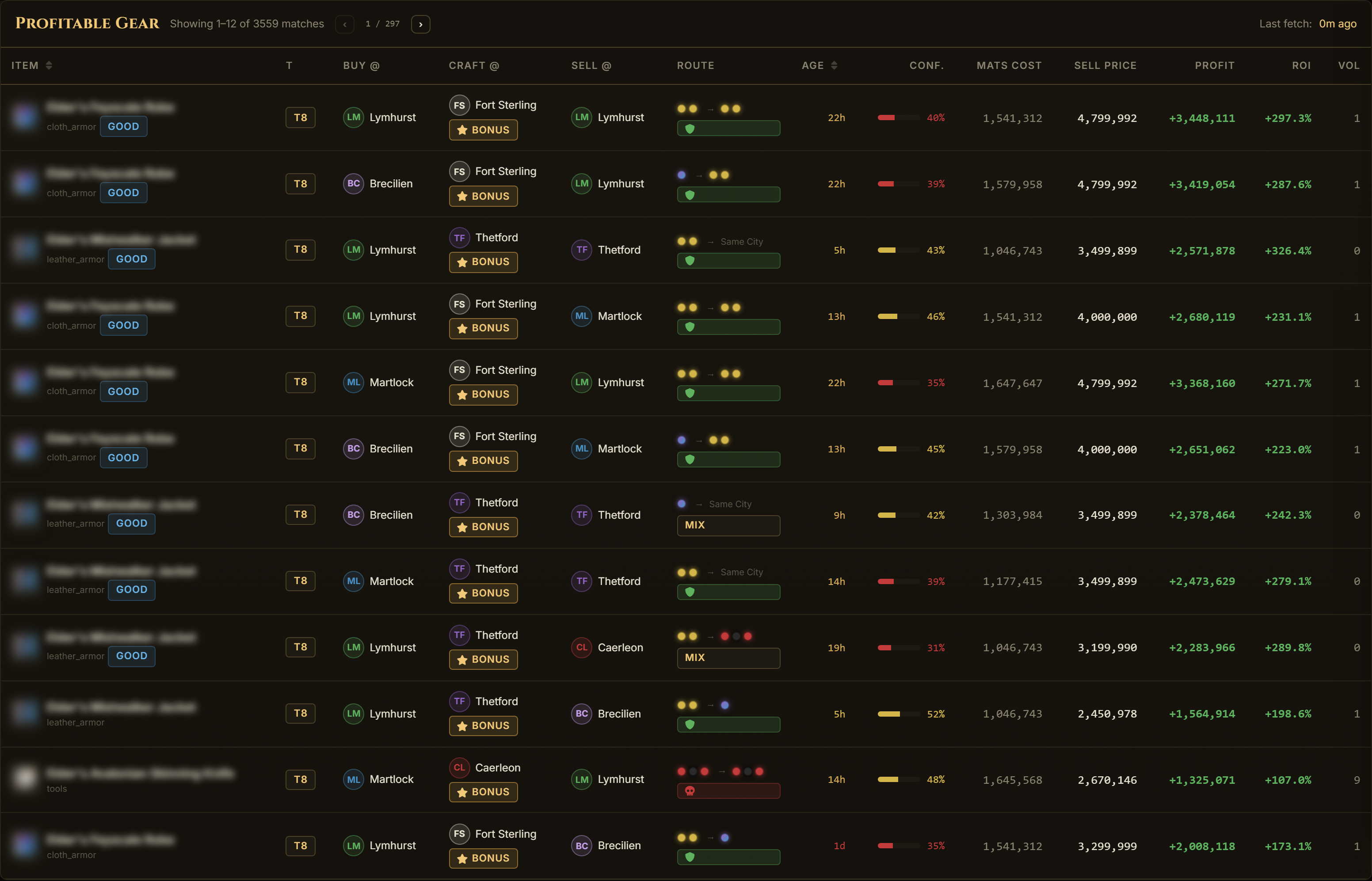
The traps are handled, not hidden: sell prices are anchored against trade history so one troll listing can't invent a margin, and every row shows its data age and a confidence score, so you always know whether you're looking at a one-minute-old market or yesterday's ghost. Open any row and the full inequality is laid out: each material priced at the buy city, the station fee, the return rate applied, against the sell price minus sales tax.
FAQ
What is the most profitable thing to craft in Albion Online?
There is no fixed answer: prices move hourly, and profit depends on your city, focus and Destiny Board specialization, because each one changes your real material cost. The reliable approach is to compute today's margins from live prices: material cost after your return rate, minus station fee and sales tax, against a sell price backed by real trade volume.
What is the crafting return rate in Albion Online?
The share of materials refunded on each craft. It runs at roughly 15% crafting in a royal city, around 24% where the city grants its production bonus for that item line, and past 40% when you spend focus. Because the refund lowers your real material cost, the return rate is the single biggest lever on crafting profit.
Does premium matter for crafting profit?
Yes. Premium halves the sales tax: 4% instead of 8%, and the tax applies to revenue, not profit. On a thin crafting margin, that difference alone can decide whether a craft is worth doing at all.
Should I sell crafts to the Black Market or a city market?
Check both per item. The Black Market in Caerleon is an NPC buyer whose orders often pay above city prices, but the orders rotate fast and reaching it means crossing red zones. City markets are safer and steadier. Compare the after-tax numbers for each piece, and read the Black Market flipping guide before hauling anything.