
Where to buy materials in Albion Online, city by city
Why every city undersells something
Ask where to buy materials in Albion Online and you'll usually get one city named: whichever one the answerer happens to live in. The real answer is per material, because every royal city runs its own market, and material prices differ between them systematically, not randomly. Each city holds refining and production bonuses for specific resource lines, so its specialists refine that material at better returns, produce it cheaper, and flood their local market with it: planks pile up in Fort Sterling, metal bars in Thetford, cloth in Lymhurst, leather in Martlock, stone in Bridgewatch. The city that refines a material cheapest usually also sells it cheapest.
Portal traffic and the surrounding farming zones shape the rest, a city fed by busy gathering routes stays stocked, a quiet one runs dry and prices climb. But the backbone is the bonus map, and because the bonuses never move, the price differences persist. This isn't a market inefficiency waiting to be arbitraged away; it's geography.
The single-city tax you don't see
The default way everyone crafts: stand in one city, buy everything the recipe needs off the local market, press the button. For a recipe with one material that's fine. For a multi-material recipe it's almost never optimal: a sword wants planks and metal bars, and the cheapest planks and the cheapest bars are, by the geography above, in different cities. Wherever you stand, at most one of your materials is in its home market. The rest you're buying at a visitor's markup.
The fix is arithmetic, not cleverness. For each material, take the minimum over cities of price × amount needed; sum those minimums; compare against the best single-city total. That per-material min() is the whole idea, and the gap it exposes grows with the recipe: the more distinct materials and the bigger the load, the wider the spread between "buy it all here" and "buy each thing where it's cheap." And every silver of that spread lands directly on your crafting profit: the sell price doesn't move, the taxes don't move, only the cost side drops.
When the trip pays: and when it doesn't
Cross-city shopping isn't free. A multi-city run costs travel time, and some legs cross zones where other players can kill you and take the cargo. That makes this the same trade market flippers price every day: a margin on paper versus a route in the world, and the margin only counts if it survives the route. Small savings on a single craft rarely do: riding twenty minutes to save 3,000 silver is paying yourself worse than any gathering laborer.
The lever that changes the math is batching. The trip's cost is fixed; the saving scales with load. Shop for one craft and the detour eats the margin. Shop for a week of crafting: fifty swords' worth of planks and bars, each line bought in its home city on one circuit: and the same detour is amortized across every craft it feeds.
Plainly: a 4% saving on one craft doesn't survive one death on the road. A 4% saving on fifty crafts is a business. If you won't batch, buy local and keep your travel time.
Keeping the plan honest
A shopping plan is a bet on prices you haven't paid yet, and it goes wrong in two boring, predictable ways. First, staleness: a "cheapest city" computed from a listing nobody has confirmed since yesterday sends you on a trip for nothing, the stock may be long gone, and you arrive to a market that never had the deal. Before riding anywhere, know how old every price in the plan is; the oldest price in the basket is the one that decides whether the trip was real.
Second, bait: one weird listing can fake a cheap city. A single underpriced lot: a mislisting, or deliberate bait, makes a city look like the source for a material it can't actually supply at that price in volume. The same discipline that keeps sell-side revenue realistic applies to the buy side: one listing is an anecdote, not a market. A real home market is deep: many sellers, steady volume, and that's what you're routing toward, not one lucky line.
The patient variant: buy orders
Everything above assumes instant buying, paying the ask, walking away with the goods. The patient variant is to place buy orders below the ask and let the market come to you: gatherers and refiners dumping stock will fill a standing order rather than list and wait. Done in a material's home city, where supply is heaviest, it stacks both discounts, the city's structural glut and the spread between bid and ask.
The cost is time and certainty. An order may fill overnight, in pieces, or never: and a margin that was live when you placed it may be gone by the time the materials arrive. So split the job: instant buy when a craft is profitable right now and speed is the edge; buy orders for the staples you craft on a schedule, where you know you'll need a thousand bars next week no matter what the market does in between.
Doing it without spreadsheets
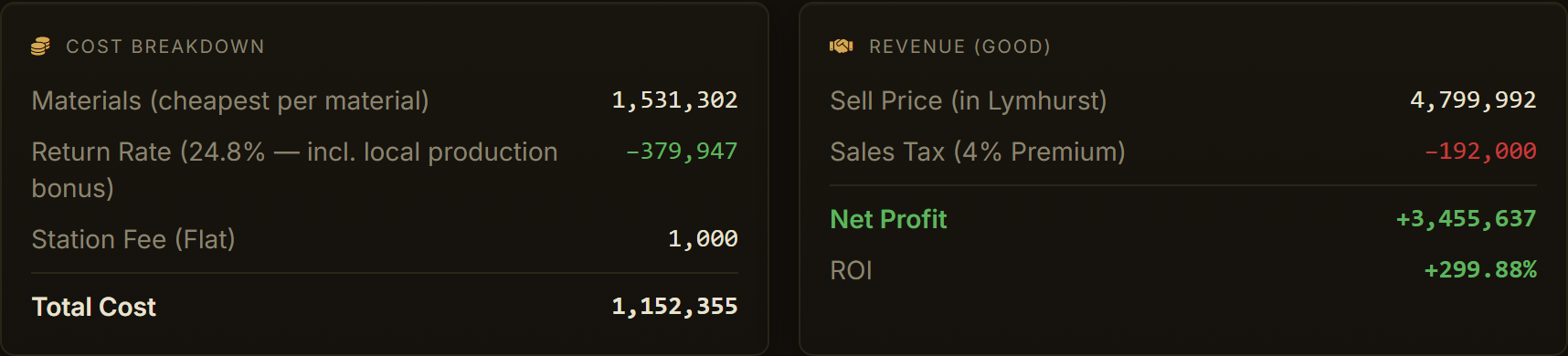
The per-material min() is trivial for one recipe and unbearable for forty: every material times every city, re-checked every time the market moves. It's exactly the arithmetic that automates. With Cross-City Shopping switched on, Profit Forge prices each material of every recipe in whichever city sells it cheapest and turns the result into a literal shopping list: each material, its source city, unit price and line total: with the multi-city total shown against the best single city, so the savings line tells you whether the trip is worth riding before you saddle up. The route map fans every source city into the craft node, and one red-zone leg marks the whole plan dangerous. The freshness column shows the oldest price across all source cities: a bargain resting on a day-old listing announces itself.
Materials are only half of a craft's cost story, which path you take to the finished item is the other half, and the enchanting guide covers how the same table prices that choice. Together they answer the two questions every craft hides: where the inputs are cheapest, and which road turns them into the item for less.
FAQ
Where should I buy crafting materials in Albion Online?
Per material, in the royal city whose refining bonus floods that market: planks in Fort Sterling, metal bars in Thetford, cloth in Lymhurst, leather in Martlock, stone in Bridgewatch, as a rule of thumb. But cities drift and undercut each other, so the honest answer is to check live prices per material before you commit.
Why are materials cheaper in some cities?
Each royal city holds refining and production bonuses for specific resource lines, so its specialists produce that material at better returns and flood the local market with it. Portal traffic and nearby farming zones shape the rest. The differences are systematic, not random: which is why they persist.
Is it worth traveling to buy materials in another city?
Only when the saving beats the trip's time and risk. For one small craft it usually doesn't; for a batch it usually does, because one shopping run can supply dozens of crafts while the travel cost stays fixed. Total the per-material savings first, then decide whether the route is worth riding.
Should I use buy orders or instant buy for materials?
Instant buy is immediate and certain; buy orders placed below the ask are cheaper but slower, and they may never fill. Use instant buy when a margin is live right now, and buy orders for staples you craft on a schedule and can afford to wait for.