
Albion Online cooking: the food business, explained
Food's two demand engines
Albion Online cooking looks like alchemy's little sibling, another consumable craft, another stack of buff items, but it sells into a market no other craft has. Food has two demand engines running at once. The first is the familiar one: players eat buff food before PvP, dungeons and gathering runs, and eaten food is gone, so they come back. The second is the one most crafters never price in: out in the outlands, guild territories and hideouts consume food as upkeep. A claimed territory doesn't ask whether it's hungry: it eats on schedule, forever, and somebody in that guild has to keep the larder stocked.
That second engine is why food is arguably the steadiest consumable market in the game. Institutional demand is bulk, regular, and price-insensitive: the quartermaster restocking a hideout before a season push is buying thousands of units on a deadline, not haggling over five percent. Player demand spikes and fades with content; upkeep demand just ticks. A cook sells into both.
The three-input kitchen
Here is cooking's real structural edge, and it's on the buy side. Recipes draw from three separate input economies: crops grown on island farm plots, meat raised from island livestock, and fish pulled out of the water by actual fishing rods. Those three markets move for completely different reasons, a replanting cycle shifts crop supply, livestock decisions play out on their own clock, and fish supply follows how many people happen to be fishing this week, not anyone's planting choices. (The fish side is a whole economy of its own: the Fish Economy view exists precisely because a fish has more than one way to become silver.)
Because the inputs move independently, so do the dishes. A recipe is a basket: some crops, some meat, maybe a fish, and a dish swings profitable when its particular basket goes cheap: a fish glut after an event, a crop overshoot after farmers chased last month's prices, a meat shortage nobody restocked. Two dishes that sell to the same buyers can sit on opposite sides of profitable purely because of what's in the pot. That's the craft's defining skill: good cooks watch the ingredients, not the menu, and find the margin before the crowd notices the basket got cheap.
The cost sheet, briefly
The arithmetic skeleton is the one every Albion craft shares, so a summary will do. Your crafting return rate hands back a share of ingredients: roughly 15% base in a royal city, around 24% in the city holding your food line's production bonus, past 40% with focus: and returned ingredients are cost you didn't pay. The station fee charges you per craft, the sales tax takes 4% of revenue with premium and 8% without, and batch yields, one craft action producing multiple units of food: divide the whole craft's cost across the stack, so pricing one unit against one craft quietly wrecks the math. The alchemy guide walks this same cost sheet line by line for potions; every word of it applies to a stew.
Volume dishes vs niche dishes
With costs priced, the strategic choice is what kind of cook to be. The favorite dishes, the meta buff foods every ZvZ caller demands and every dungeon runner carries, trade in enormous volume with thin margins: you can sell as many as you can cook, but so can everyone else, and the competition shaves the margin to a sliver that only pays at scale. The niche dishes: utility foods, lower-tier stews, the odd recipe that feeds upkeep rather than fights, trade slower but fatter: fewer buyers, but hardly anyone competing to supply them, so the per-unit margin survives.
Neither is the wrong answer. High volume and thin margins reward the cook who can commit stacks of ingredients and move product daily; fat margins on slow sellers reward the patient one who'd rather list and wait than grind throughput. What matters is choosing deliberately: and checking that the volume you're counting on is real, not assumed.
Plainly: the famous buff food pays like a famous trade, everyone's already in it. If a dish's profitability is common knowledge, assume the margin has been cooked away and verify before you shop.
Input dip or real margin?
Because cooking margins are born on the input side, the trap is mistaking a one-day ingredient dip for a standing business. Someone dumps a fishing haul below market, a dish's computed margin jumps, and by the time you've bought the rest of the basket at normal prices the bargain is gone. Before committing a shopping trip, look at the price and volume history on both sides: is the ingredient cheap this hour or cheap this month? Does the dish actually sell at your assumed price, in volume, or did one optimistic listing set your revenue line?
The same discipline applies to data freshness. A margin computed from an ingredient price nobody has confirmed since yesterday is a guess wearing a number's clothes: knowing how old each price is matters more in a three-input craft, because the staleness of the worst ingredient is the staleness of the whole plan.
Doing it without spreadsheets
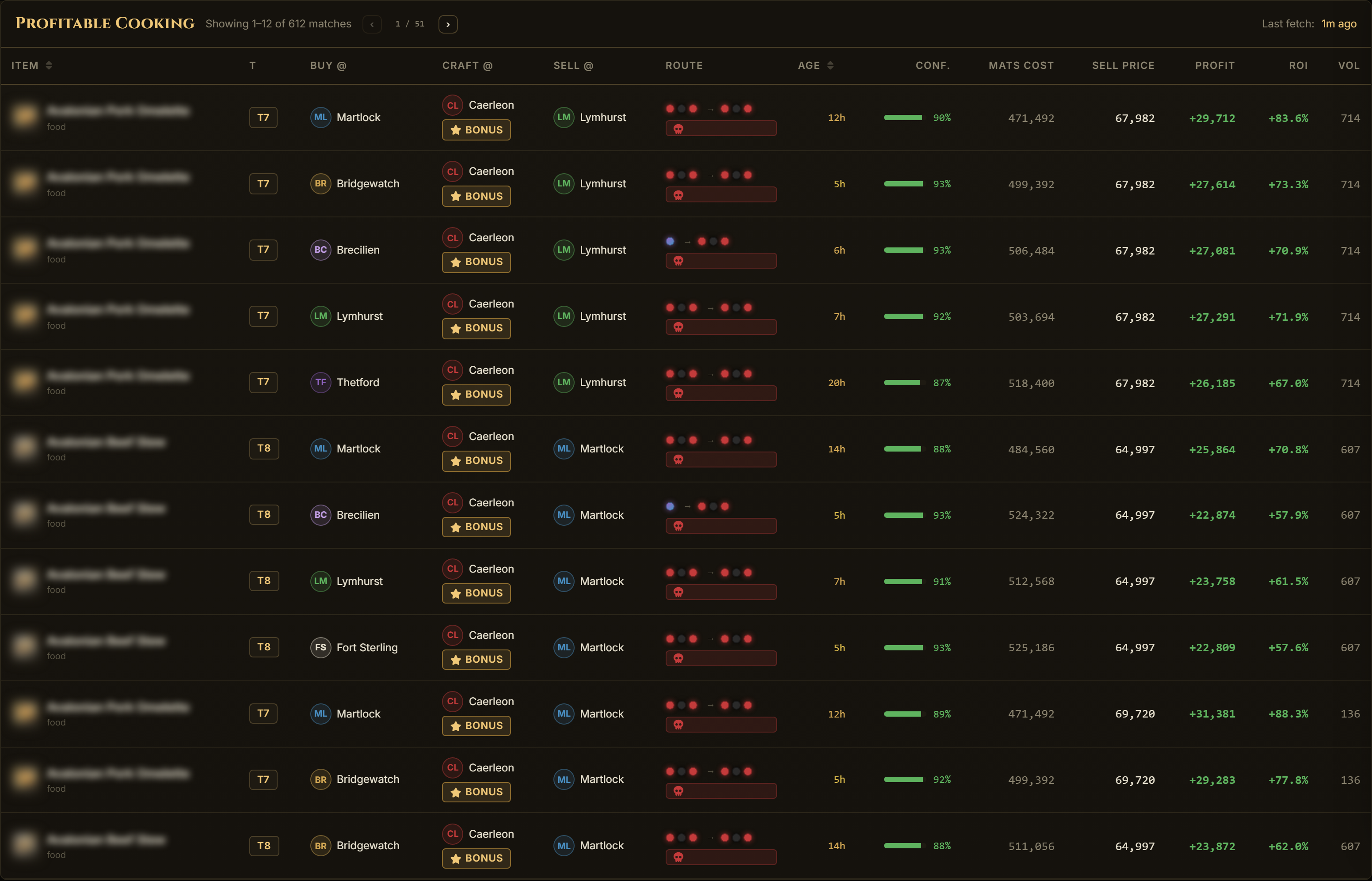
Everything above is arithmetic on live prices, three input markets times every recipe, minus returns, fees and tax, divided by batch yields, re-asked whenever any of the three moves, which means it automates. The Profit Forge cooking tab prices every dish at every tier, live: where to buy the crops, meat and fish, where to craft, where to sell, with your return rate, station fee, tax and batch yields already inside the number and sell prices anchored so one troll listing can't invent a margin. Each row carries the age of the stalest price in its math, a confidence score, ROI and the sold volume that separates a real market from a hopeful one, and since a recipe's ingredients are rarely all cheapest in one city, the cross-city shopping list prices each ingredient where it's actually cheapest and tells you whether the trip beats buying it all in one place.
FAQ
Is cooking profitable in Albion Online?
Yes: food demand never stops, because players eat buff food for content and outland territories and hideouts consume food as upkeep. The margin depends on pricing your inputs live: dishes swing profitable when their particular mix of crops, meat and fish goes cheap.
What food should I cook to sell?
Whichever dish's ingredients are currently cheap; there is no permanent answer. Crop, meat and fish prices move independently, so the profitable dish rotates with its input basket. Check live prices on both sides before every batch instead of following a static list.
Why does food always sell in Albion Online?
Two demand engines run at once. Players eat buff food for PvP and PvE and come back for more, and guild territories and hideouts in the outlands consume food as upkeep, so guilds buy it in bulk, steadily, and without haggling over small price differences.
Where should I cook in Albion Online?
Preferably in the city holding the production bonus for your food line: the higher return rate lowers your cost per dish. Weigh that against station fees, where your ingredients are cheapest, and where the finished food actually sells in volume.