
How to make silver in Albion Online
Where silver actually comes from
Ask how to make silver in Albion Online and you'll get a hundred answers, most of them a farming route someone recorded last patch. Strip the noise away and every silver coin in the game arrives through one of three engines: killing things, mobs, dungeons, faction fights, the whole PvE income stream, trading price differences, and producing value through the crafting economy. The first engine scales with hours played: more grind, more silver, and no guide changes that arithmetic much.
This page maps the other two, because that's where profit stops being grind and becomes math. Every method below is ranked honestly: what it is, who it suits, and the one number that decides whether it pays. They're ordered by entry cost: from silver you can make with empty pockets to trades that reward deep capital and deep specialization.
The four numbers that rule everything
Before the tour, the physics. Every method on this page: flipping, crafting, refining, all of it: lives or dies on the same four numbers:
Margin after tax. Every market sale pays sales tax: 4% with premium, 8% without, plus a 2.5% listing fee if you post a sell order instead of feeding a buy order. A margin that looks fat before fees is often theater after them. Volume. A 300k margin on an item that sells twice a week is worse than a 20k margin on one that sells by the stack, volume caps how much of any margin you can actually realize. Price freshness. Markets move constantly; a price observed yesterday may belong to an order long filled. The age of your price data is the difference between a real margin and a remembered one. Your real costs. Hauling risk, station fees, your return rate, and the occasional troll listing posted at fantasy prices to bait sloppy math: count them, or the market counts them for you.
One more law: every method on this page stops working the moment everyone does it. Margins exist because someone isn't looking, which is why the real answer to "how do I make silver" is a method for finding today's answer, not a list of items to farm.
Starting from zero
Fishing is the only economy in the game with no entry fee at all: a starter rod, some bait, and open water. The catch: literally: is that most fishers throw away half their earnings at the point of sale, because every fish has four possible exits: sell it raw, chop it into filets, turn it into sauce, or cook it into a meal, and the best-paying exit changes per fish and per day. The number that decides it: the best exit price per fish, not the fish's own listing. The full breakdown is in the fishing economy guide.
Salvage flipping is the market's habit of mispricing its own goods: players dump gear below the value of the materials inside it, and salvaging recovers a fraction of those materials. Buy the underpriced piece, break it, sell the parts, on the same city market, so there's no hauling and nothing to gank. It suits anyone with pocket silver and patience; the deciding number is the gap between the gear's asking price and its salvage-return material value after tax. The salvage guide walks the math.
Trading: silver from price gaps
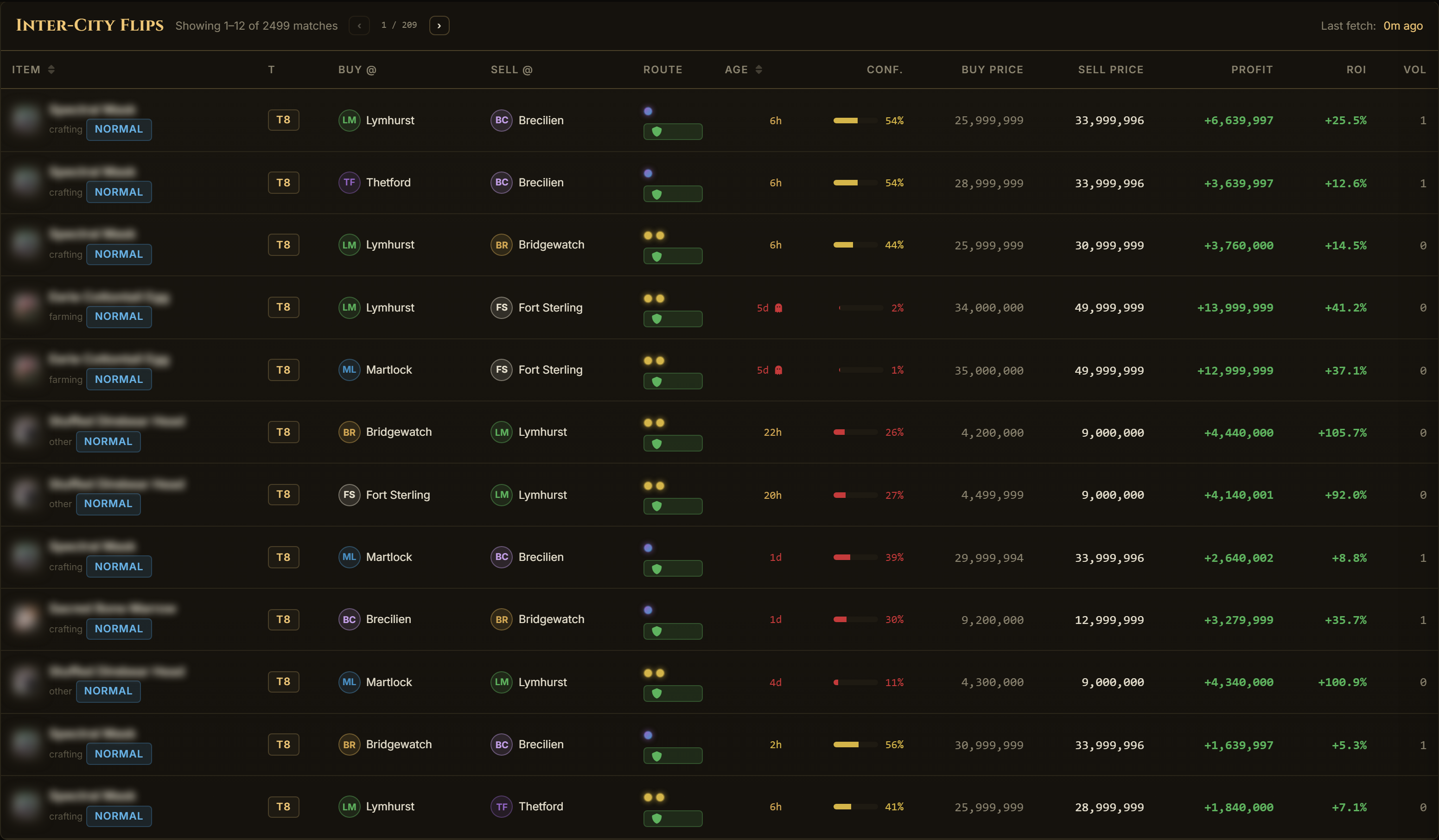
Market flipping is the classic: buy an item where it's cheap, haul it to where it's expensive, pocket the spread. Each royal city's crafting bonuses and local demand keep prices permanently out of sync, so the gaps regenerate no matter how many traders feed on them. You need starting capital, a mount, and the stomach for the real risk: the road, where your cargo is somebody else's loot table. The deciding number is the spread after tax, listing fee, and an honest estimate of hauling losses. The market flipping guide covers routes, risk pricing, and the traps.
Black Market flipping is trading with an NPC counterparty: the Black Market in Caerleon only buys gear, feeding it back into the world as mob and chest loot, and when players farm loot faster than sellers supply it, its buy orders climb above city prices. Sell into those bids: with bought gear or your own crafts: and you're paid the premium. The cost is the trip: every road to Caerleon is red. The deciding number is the BM bid minus your city cost minus tax, weighed against the ganking risk. Full treatment in the Black Market guide.
Transmutation is arbitrage on a ladder the game itself provides: pay a silver fee to convert reagents, royal sigils and maps up a tier, and profit whenever the market prices two rungs further apart than the fee between them. No hauling, no combat, no Destiny Board: just rungs drifting in and out of profitability as prices move. It's a scanner's trade: the deciding number is output price minus input price minus the fee, checked often, because everyone can see the same ladder. Details in the transmutation guide.
Production: silver from value added
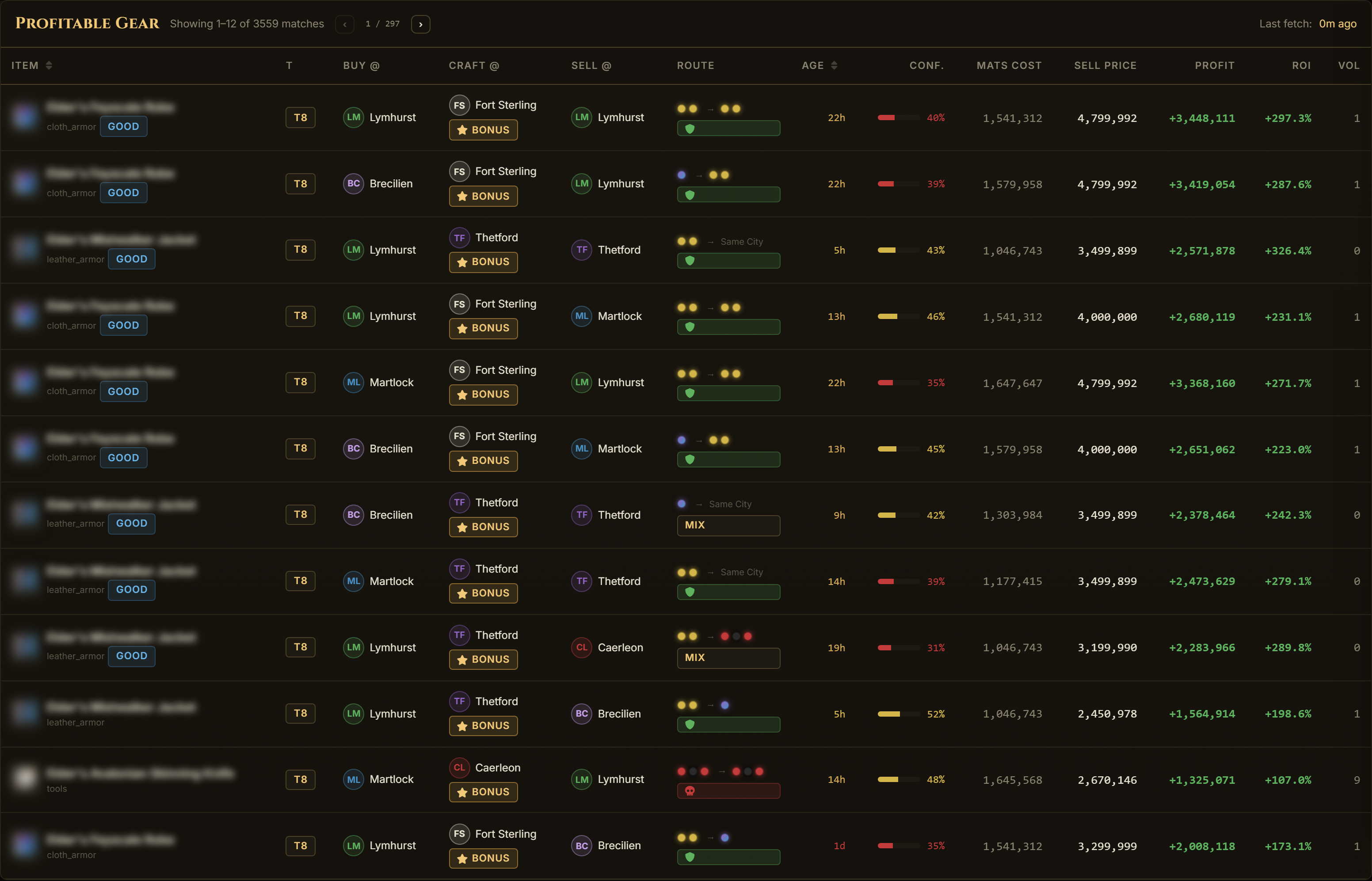
Gear crafting is the deepest business in the game, and the most misunderstood, because a craft's real cost isn't the material price: it's the material price after returns. Resource return rates (roughly 15% base, ~24% in an item's bonus city, 40%+ with focus) mean two crafters making the same item can have wildly different cost bases, and the one crafting in the right city with focus is profitable where the other is donating silver. The deciding number is your personal net material cost against the sale price after tax. The what-to-craft guide shows how to find the crafts where your numbers win.
Refining is crafting stripped to its skeleton: raw resources in, refined materials out, margin decided almost entirely by the return rate. In your refining city with focus it's a volume business that compounds quietly; outside a bonus city without focus, it's usually a slow way to lose to the market's spread, bonus city plus focus, or don't bother. The refining guide has the break-even math.
Consumables: alchemy and cooking, are the economy's renewable demand: potions get drunk and food gets eaten (by players and by territory upkeep), so the market never saturates the way gear can. Both are batch businesses where the input side picks the product: herb and crop prices move in cycles as farmers flood and abandon crops, and the profitable potion or dish is whichever one's inputs are in a glut this week. The deciding number is the input cycle, not the sale price.
The boring shelf: bags, capes, tools, is the quiet corner nobody streams about. Every character in the game wears a bag and a cape and gathers with tools, demand is flat and permanent, and because the glory crafters are all fighting over weapons, competition on the shelf stays thin and margins stay honest. It suits crafters who'd rather earn steady wages than chase spikes. The bags and capes guide makes the case.
Specialist plays
Artifact melding is the gamble you can price: feed 50 artifact fragments into the melder and get a random artifact from the outcome pool. Any single meld can win or lose big, but the pool odds are known, so the whole thing reduces to expected value: reagent cost against the weighted worth of the outcomes. Run melds only when EV is positive and in batches big enough for the average to assert itself, and it's trading; run them on a feeling and it's a casino. The melding guide does the probability work.
And once any method above is working, three mechanics multiply it. Enchanting up often makes the same enchanted item cheaper to produce than to craft directly. Cross-city shopping cuts your material bill by buying each input where its bonus city oversupplies it. And quality rerolling exploits the fact that five quality tiers are really five separate markets with separate prices. None is a method on its own; each widens the margin of whichever one you run.
Skipping the spreadsheet
Everything above is arithmetic on live prices, cost here, price there, minus tax, times volume, discounted by age. Which means it automates. Profit Forge runs exactly that arithmetic across every method on this page: crafting, refining, flipping, the Black Market, salvage, melding, transmutation, consumables, the fish economy: against live market data from every royal city, Brecilien and the Black Market, with your premium status, tax, return rates and Destiny Board applied, and re-sorts the answers every few minutes. Today's answer, pre-computed.
FAQ
What is the best way to make silver in Albion Online?
There is no single best method: it depends on your capital and risk tolerance. With nothing, fish or salvage-flip; with trading capital, flip price gaps between cities or into the Black Market; with crafting specs and focus, craft or refine in bonus cities. Every method's profit comes down to the same math: margin after tax, volume, and price freshness.
How do new players make silver fast?
Fishing and salvage flipping. Fishing needs no capital at all: cast, catch, and pick the best-paying way to sell each fish. Salvage flipping needs only pocket silver: buy gear listed below the value of its own materials, salvage it, and sell the parts on the same market: no hauling, near-zero risk.
Is crafting or trading more profitable in Albion Online?
They are different businesses. Trading turns capital over fast at thin margins and needs no Destiny Board progress; crafting earns wider margins per item but depends on return rates, city bonuses, and focus to beat simply selling the materials. Many of the game's richest players do both: craft where their spec is deep, trade everywhere else.
Do I need premium to make silver in Albion Online?
No: every method works without premium. But premium halves the sales tax from 8% to 4%, which widens every margin on every sale, and its daily focus makes crafting and refining returns dramatically better. Most full-time traders and crafters find it pays for itself, and it can be bought with in-game gold earned from these same methods.