
Albion Online alchemy: the potion business, explained
Why potions are a different business
Most crafting sells a player something they'll keep until they lose it. Albion Online alchemy sells things that get destroyed on purpose: potions are consumables, drunk mid-fight and mid-dungeon, and the player who bought a stack of heal potions for Friday's ZvZ will be back for another stack next week. A sword is sold once; a potion buyer is a subscription.
That one fact reshapes the whole trade. Demand renews permanently, so potion markets are steadier than gear markets, less feast and famine, more throughput. But the same steadiness means the money is in volume, not jackpots: unit margins are small, and the brewers who profit are the ones who price every cost exactly and move stacks, not singles.
The cost sheet: what a potion really costs
A potion's cost has four moving parts. Herbs and ingredients: the bulk of it, bought off a market that farmers supply from their island plots. The crafting return rate: the same mechanic gear crafters lean on: a base return of roughly 15% in a royal city, around 24% in a city holding the production bonus for your potion line, and past 40% when you spend focus. Returned ingredients are cost you didn't pay, so the rate belongs inside the math, not sprinkled on afterwards. Station fees: a per-craft charge that looks trivial until you multiply it across a night of brewing. And the sales tax on the way out: 4% with premium, 8% without, taken off revenue rather than profit, which is exactly where a thin margin hurts most.
Then the detail that quietly breaks most home-made spreadsheets: batch yields. A potion recipe produces multiple units per craft: five, for many recipes, so the real unit cost is the cost of the whole craft action divided across the yield. Get that division wrong, or skip the fee, or use the wrong tax rate, and a 12% margin flips sign without telling you. In a business where the margin per potion is a few hundred silver and the profit is in brewing hundreds, this precision is the strategy.
The meta-potion trap
Potion demand doesn't just renew: it spikes. Demand is event-driven: a new season resets ZvZ appetites, faction pushes drain resistance potions, a balance patch makes one build (and its potion) suddenly mandatory. When a spike hits, everyone knows which potion is hot: and that is precisely the problem. Every alchemist in the game reads the same meta, brews the same famous potion, and the flood of supply compresses its margin to nothing while the shouting is still going on.
Meanwhile the boring second string: the resistance potion nobody streams about, the gigantify, the poison, the off-tier of the meta pick: keeps selling to its steady trickle of buyers with nobody competing to supply it. Modest demand plus no competition routinely beats huge demand plus everyone.
Plainly: the potion everyone knows is profitable is the one being brewed to death. The margin lives one shelf over, on the potion nobody is talking about.
The herb cycle: why the answer is weekly
The input side has its own clock. Herbs are grown on player island farms, on a planting cycle: which means today's herb supply was decided by farmers' planting choices days ago. When a potion's margin fattens, farmers see the same herb prices you do and replant toward it; a few cycles later the harvest lands, herb prices climb, and the margin you spotted has been eaten from the input side.
So alchemy margins are cyclical by construction: potion demand spikes with content, herb supply chases it with a lag, and profitability rotates around that loop. The question is never "is alchemy profitable": it's "which potion, this week." Which also means the numbers you act on must be current on both sides: a plan built on herb and potion prices nobody has confirmed since yesterday is a plan for last week's market.
Sourcing the herbs
Herbs are a market good like any other, and like any other they're not the same price everywhere: where farmers cluster and where buyers drain stock differs city to city, and a multi-ingredient recipe rarely finds all its inputs cheapest in one place. The per-material shopping logic from the cross-city buying guide applies to a brew sheet exactly as it does to a sword: price each ingredient where it's cheapest, batch the trip, and let one shopping circuit feed a week of brewing, the same per-material math, pointed at herbs.
One buy-side caution carries over too: a single suspiciously cheap herb listing is an anecdote, not a supply. Thin herb markets are easy to bait, and the discipline that keeps sell-side revenue honest, weight the market, not the one weird listing, is the same one that keeps your ingredient costs real.
Doing it without spreadsheets
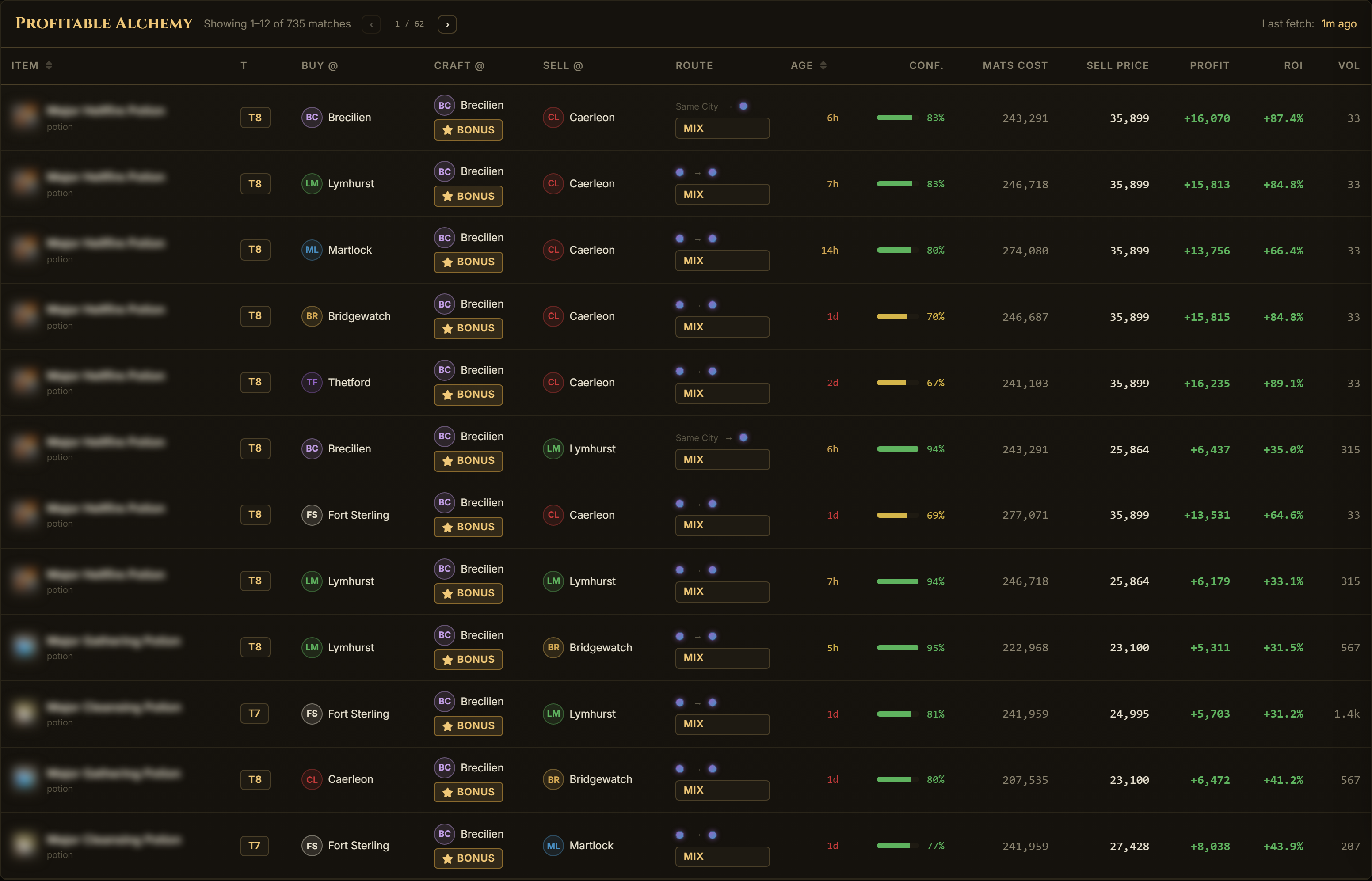
Everything above is arithmetic on live prices, herb costs times yields minus returns, fees and tax, re-asked every time the market moves: which means it automates. The Profit Forge alchemy tab prices every potion recipe at every tier, live: where to buy the ingredients, where to craft, where to sell, with batch yields handled correctly, the craft action priced against the five-unit sale, not one, and your return rate, station fee and tax already inside the number. Each row carries the age of the stalest price in its math, a confidence score, ROI and the sold volume that tells you whether the margin can actually be moved in bulk. The table re-sorts as prices come in, so the "which potion, this week" question has a standing answer.
FAQ
Is alchemy profitable in Albion Online?
Yes, but as a volume business, not a jackpot. Per-potion margins are thin, so profit depends on batch yields, your return rate, fees and tax being priced exactly: and on picking the right potion for this week's herb prices, which rotate constantly.
What potions should I craft in Albion Online?
There is no permanent answer: the profitable potion rotates with herb prices and content cycles. The famous meta potion is usually overbrewed and thin, while second-string potions quietly pay. Check live prices on both sides before every batch.
Where should I craft potions?
Preferably in the city holding the production bonus for your potion line: the higher return rate directly lowers your cost per potion. Weigh that against station fees, where the herbs are cheap, and where the finished potions actually sell in volume.
Do I need focus for alchemy?
No, but it helps a lot. Focus pushes resource returns past 40%, versus roughly 15% base in a royal city and around 24% in a bonus city: and on thin per-unit margins that difference is often the whole profit. Without focus, stick to potions whose margin survives base returns.