
Nobody crafts just one
The gap an Albion Online craft planner closes
A profit table answers one question: is a single craft of this item profitable right now? Useful: but nobody crafts once. The moment you decide to make fifty instead of one, you've left the question the table answered and entered the territory an Albion Online craft planner exists for: execution at quantity. Scaling doesn't just multiply the numbers you liked; it multiplies every number, including the ones you didn't look at, and it introduces failure modes a per-unit margin can't even express.
Four of them, specifically. Material arithmetic: how much do you actually buy when the return rate gives some of it back? Price depth: the cheapest listing is not the price of the five-hundredth unit. Budget: can your bankroll carry the batch at all? And drift: prices move while you shop. Each is survivable; unexamined, each one quietly converts a paper margin into a real loss.
Gross vs net: the returns arithmetic
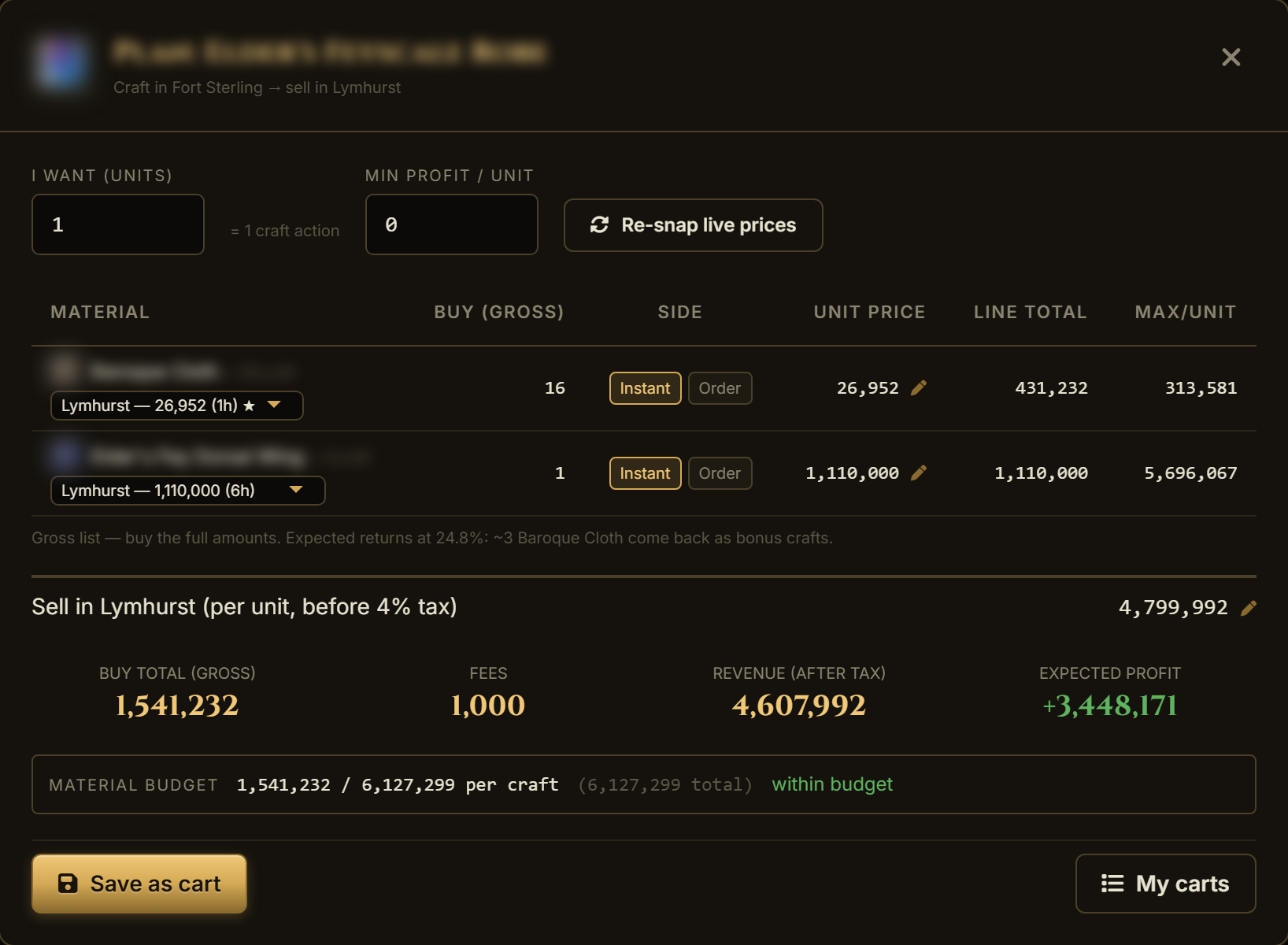
The return rate is where most batch plans go wrong first. If a recipe eats 16 planks per craft and your station returns a share of resources, it's tempting to shop for less than 16 per craft, "returns will cover the rest." They won't, not the way you think: returned resources come back during crafting, effectively as bonus crafts, not as a discount you can apply at the market stall. Plan with net amounts and you underbuy, the batch stalls short with the station fee already spent.
The correct arithmetic is unglamorous: buy the full gross amounts: recipe times craft count, no discount, and treat the returns as extra finished items that lower your effective cost per unit. Buy gross, value net. The opposite mistake exists too: shopping gross but pricing the batch as if the returns weren't coming overstates your cost and talks you out of crafts that pay. Batch yields add a second wrinkle: recipes that produce multiples per craft action mean "I want 12" is rarely exactly 12 out the other end.
Shopping the plan: city and side, per material
A shopping list is not just amounts, every line carries two decisions. Where: the cheapest planks are rarely in the same city as the cheapest bars, and at batch quantities the gap between cities stops being pocket change; that's the whole logic of cross-city shopping, applied line by line. How: instant-buy pays the current ask and fills now; a buy order bids below the ask and fills when a seller comes to you: cheaper, but patient, and patience is a real cost when the sell-side price that justified the batch won't wait forever.
Depth is the third, quieter decision. The ask you see is the price of the first unit, not the five-hundredth, buying deep walks up the book, and no public data source reports how many units sit at each price. Large batches deserve humility: assume your average paid price lands above the headline ask, and let the margin survive that assumption before you commit.
The budget check
"I'll craft 100" is a plan; "I can afford to craft 100" is a different claim, and only one of them is checked against your bankroll. A batch whose material bill exceeds what you can spend is a fantasy with good production values, you'll buy half the list, run dry, and hold a pile of intermediate materials that were never the thing you meant to own. Working the arithmetic backwards is the honest move: from the sell price, subtract tax and fees, subtract the margin you're doing this for, and what remains is the material budget per craft: the most you can pay for a craft's inputs before the batch stops being worth executing. Divide your actual bankroll by that number and "100" becomes whatever it really is. Often it's 30: and an executed 30 beats a stranded 100 every time.
The per-material version of the same idea is a breakeven ceiling: the price at which one material, at current prices for the others, eats the margin. Bought half your stock cheap and the rest is listed higher? The ceiling tells you whether the remaining units are still worth buying: mid-shop, when the answer actually matters.
Plan, execute, record
A plan you can't check off is a plan you'll abandon by the third material. The working pattern is to save the plan as a cart: a tracked list you shop against, recording what you actually bought and sold, at the prices you really paid, session by session. Actuals diverge from the plan; they always do. That divergence isn't failure, it's information, and recorded reality, not the forecast, is what your profit records should be built from. Plan → execute → record → learn is the whole workflow; skip the recording step and every batch teaches you nothing about the next.
The snapshot problem
One more honesty check before you ride: a plan is a snapshot, and it starts aging the moment it's made. The prices that justified the batch were true when you looked: sellers relist, orders fill, and an hour of hauling can move the sell side more than your margin is wide. Before executing a plan you made earlier, re-check its prices against the market's current state, and treat the age of the data under any number as part of the number.
Plainly: a plan made this morning is this morning's plan, the market didn't agree to hold still while you shop. No planner can promise fill prices or order-book depth; what it can do is show you honest numbers and their age, and let you re-snap before you spend.
Doing it without spreadsheets
All of the above is arithmetic on live prices, which means it automates. In Profit Forge, any result row opens into the free craft planner: say how many you want, and it produces the gross shopping list, every material with its city pick and an instant-buy or buy-order toggle per line: plus fees, revenue after tax, expected profit, and the expected returns shown as an info line rather than silently pre-subtracted. The material budget check compares the batch's cost against what the profit equation says you can spend per craft, and "Save as cart" turns the plan into the tracked list you'll actually shop, record, and complete.
FAQ
How do I plan a crafting batch in Albion Online?
Start from a craft you have verified is profitable per unit, then scale deliberately: compute the full gross material amounts for the quantity you want, pick where to buy each material and whether to pay the ask or post a buy order, check the total against the silver you can actually spend, and write the plan down before you shop. A planner that turns a result row into a shopping list with a budget check does all of this in one step.
How many materials do I need with the return rate?
Buy the full gross amounts: the recipe quantity times the number of crafts, with no return-rate discount. Returned resources come back during crafting as bonus crafts, not as materials you can skip buying up front. Planning with net amounts underbuys and strands you mid-batch; the correct arithmetic is to shop gross and treat the returns as extra output that lowers your effective cost per item.
What is a craft planner in Albion Online?
A tool that turns "craft N of this item" into an executable plan: the gross shopping list per material, where to buy each one and on which side of the order book, the expected fees and revenue after tax, the projected profit, and a check of the material cost against your budget. Good planners also save the plan as a trackable cart so you can record what you actually bought and sold.
Can I track what I actually bought and sold?
Yes: save the plan as a cart and record purchases and sales as they happen, at the real prices, session by session. Actuals always drift from the plan, and the recorded reality is the number that matters: it becomes your realized profit and feeds your long-term profit records, so every batch teaches you something about the next one.