
Your silver balance is lying to you
The problem an Albion Online profit tracker has to solve
Your silver went up this week, so the crafting must be working, right? That inference is the most expensive mistake in Albion Online's economy, and it's why an Albion Online profit tracker is less a tool than a discipline. The balance in the corner of your screen is one number summing everything at once: loot you sold, quest and faction rewards, a flip that happened to land, and your crafting margin: which may well be negative and drowned out by the rest. "I have more silver" and "my crafting makes silver" are different claims, and the balance can only ever support the first.
Memory makes it worse. Players remember the batch that cleared two million and forget the twelve batches that each quietly lost fifty thousand: a scoreboard kept by feel always flatters the keeper. Without records, you don't have a profit figure; you have a mood.
What real traders know
Three ideas from real-world trading transfer to a game economy intact. First: realized versus paper profit. A margin on a calculator screen is not income, it's a forecast that becomes income only when both sides execute: you actually bought the materials at that price and actually sold the output at that price. Between forecast and fill, prices move, orders rot, and the data your margin rests on ages. Only the filled trade counts.
Second: cost basis honesty. Materials you gathered yourself are not free. Every ore you smelt is ore you could have sold, so a craft that "only cost me time" really cost the market value of everything it consumed: the same goes for focus you could have spent elsewhere. Ignore that and your book shows a profit that is actually you underpaying yourself.
Third: fees are real costs. Every sale pays sales tax: 4% with premium, 8% without: and a sell order pays a 2.5% listing fee on top, filled or not; crafting adds station fees. These come off revenue, not profit, which is exactly why thin margins that look positive before fees are negative after them.
What to actually record
A usable book needs surprisingly few columns. For every buy: quantity, unit price, and the city you paid it in. For every craft: what it consumed at market value, plus the station fee and any focus spent. For every sale: quantity, unit price, city, and the tax and listing fee that came off the top. The profit of a record is then arithmetic, not opinion: recorded revenue minus recorded spend minus fees.
The one structural rule: keep activities separate. A single lump total answers nothing, the question that changes your behavior is which line pays. Was it the potion crafting, or the lucky armor flip riding along in the same week? Split the book by activity and each one has to justify itself; merge them and the winners launder the losers indefinitely.
Records that write themselves
Here is why almost nobody does any of this: bookkeeping after the fact is a chore, chores get skipped, and a ledger with gaps is just a mood with formatting. The spreadsheet approach dies the evening you're tired and skip "just this one session", which is, statistically, the session with the loss in it.
The fix is structural: records should be created where the action happens, not reconstructed afterwards. When a planner cart turns "craft 20 of these" into a shopping list, ticking off each purchase at the price you really paid is the bookkeeping, and recording sales as they fill, partially or all at once, completes the entry. Whatever happens outside a cart gets a manual entry; whatever got fat-fingered gets edited or deleted in place, with the totals adjusting by exactly the difference. And the book must export: a ledger you can't take with you as CSV is a ledger you don't own.
Reading your own book
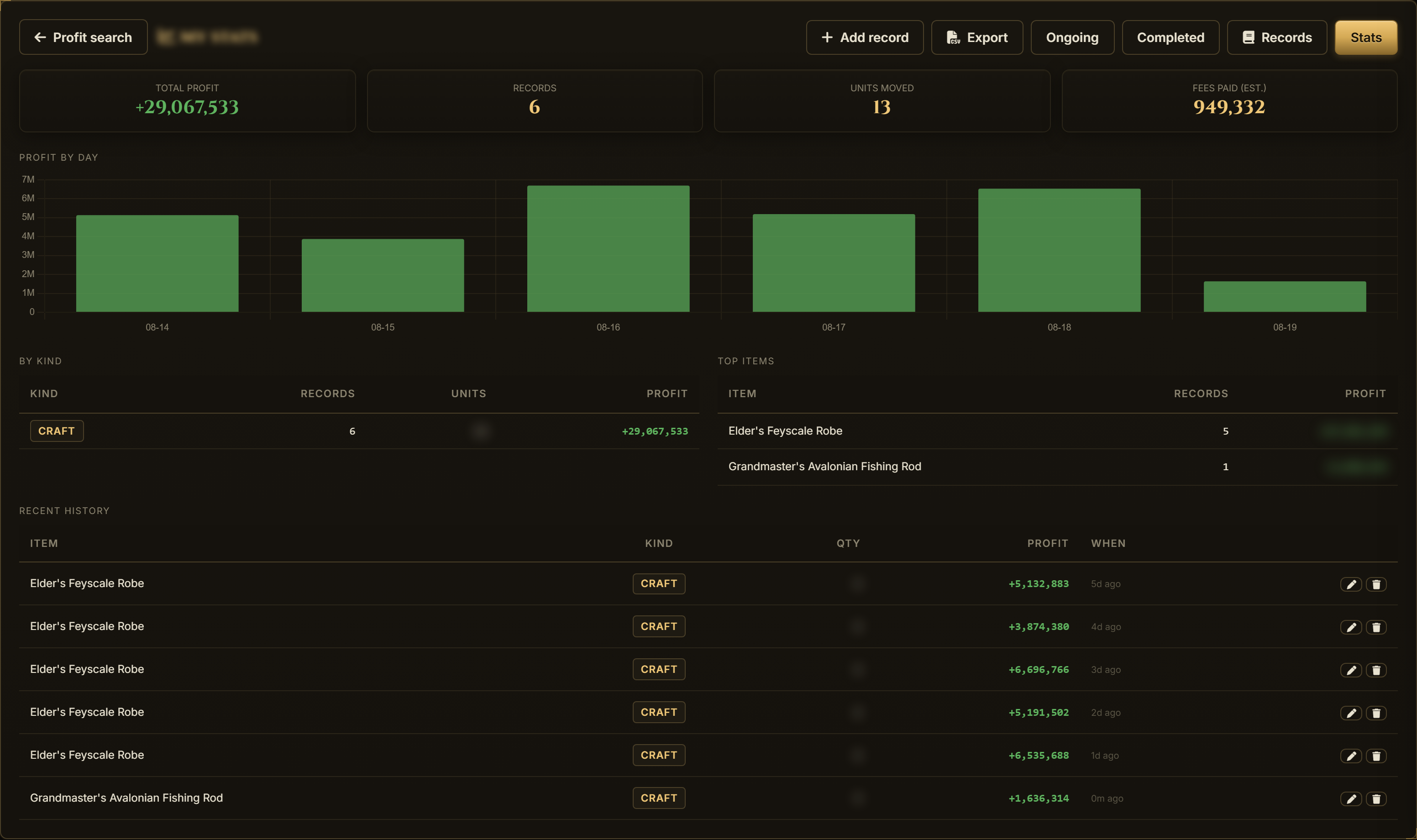
Records answer "what happened"; the aggregates answer "what should I keep doing". Four numbers do most of the work: total realized profit, the split between crafting and flipping, the items that actually earned it, and profit by day, because a line that made silver in one lucky spike is a different business from one that earns steadily.
Be clear about what a ledger does: it does not make you profitable, it makes you honest. Its job isn't to celebrate your wins; it's to make your losses impossible to ignore. The player who discovers their beloved craft loses silver stops doing it, that moment is the ledger paying for itself.
Doing it without spreadsheets
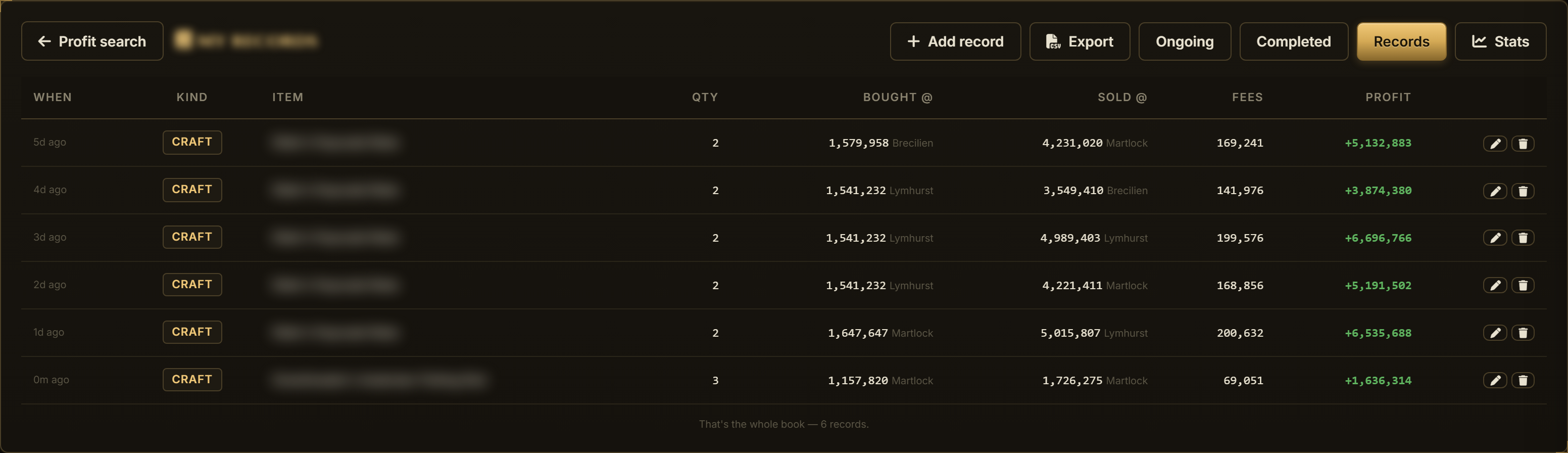
Everything above works in a spreadsheet; the discipline just rarely survives contact with a play session. The profit ledger in Profit Forge is that book kept from inside the workflow: planner carts record your buys and sells as you tick them off, manual entries cover the rest, and the Records book keeps every row: what you paid and where, what it sold for and where, fees, and realized profit: each one editable or deletable, the whole history exportable as CSV.
The Stats view reads the book for you: total recorded profit, the craft/flip split, top items and recent activity: and those totals survive even if you delete the carts that produced them. The planner and the ledger are free features: keeping honest books costs nothing.
The ledger closes a loop the other tools open: the price checker tells you what the market says before you commit; the ledger tells you what actually happened after. Run both and forecast versus fill stops being a guess.
FAQ
How do I track profit in Albion Online?
Record every buy and every sale as it happens, quantity, unit price, city, and the fees on the sale, and keep crafting separate from flipping so each activity's total stands on its own. A spreadsheet works if you keep it honest; the free ledger in Profit Forge keeps the same book with less friction, recording purchases and sales as you tick them off in a planner cart.
Why does my silver balance not tell me my profit?
Because it is one number summing everything at once: loot income, quest and faction rewards, market luck, and your crafting margin, positive or negative. A rising balance can hide a crafting line that loses silver on every batch. Only per-activity records can tell you which of your activities actually pays.
Do I have to enter every trade by hand?
No. Records can be created from the workflow itself: plan a craft or flip in a cart, tick off purchases and sales as they happen, and the ledger entries are written for you. Manual entry covers anything done outside a cart, and every record can be edited or deleted afterwards if you fat-fingered a number.
Can I export my Albion Online profit records?
Yes: the whole record history exports as a CSV file, so your data stays yours. Open it in any spreadsheet, run your own analysis, or simply keep a backup outside the app.