
One item, dozens of prices
What an Albion Online price checker actually has to answer
"What's a Claymore worth?" sounds like one question. In Albion Online it isn't, because the game has no global auction house: each of the five royal cities runs its own player-driven market, and so do Caerleon in the middle of the red zones and Brecilien out in the Mists: plus the Black Market, an NPC that posts its own buy orders. The same sword has a separate price in every one of those markets, for every quality from Normal to Masterpiece, for every enchantment level. Answering the question honestly means reading dozens of numbers, which is why an Albion Online price checker worth using shows you a grid, not a single figure.
The in-game market board makes this worse, not better: it only shows the orders of the city you are physically standing in. To compare Martlock against Lymhurst the honest in-game way, you ride, through open-world zones, both directions, for one data point.
How players cope: chat, alts and guessing
So players improvise. They ask city chat, and get answers that are stale, wrong, or trolling: sometimes from the very trader whose margin depends on you mispricing. They park alt characters in other cities and relog to eyeball a market board. Or they skip the homework and guess.
Guessing has a price tag. Cities' markets genuinely diverge: that divergence is the entire basis of market flipping, so listing an item at your home city's instinct price in a city that pays one spread more or less is silver handed to whoever did check. Mispricing by one city's worth of spread doesn't sting once; it stings on every trade you make.
Where community price data comes from
There is no official price API. Every community price tool: all of them: stands on the Albion Online Data Project (AODP), a donation-funded community effort: players run a small client that uploads the market orders they browse while playing, and the pooled result is served publicly. When you look up a price without leaving your city, you are reading the order book some other player scrolled past, minutes or days ago.
That origin story carries an honesty requirement. The data is crowd-scanned, so it is exactly as fresh as the crowd: a heavily-traded market in a busy city gets scanned constantly, while a thin market nobody browsed since Tuesday still reports Tuesday's prices. Nothing about the number itself tells you which case you're looking at: only its age does.
Reading a price like a trader: age and volume
Two habits separate players who read prices from players who get read. The first: never trust a price without its age. A "current" price observed four days ago may belong to an order long filled or cancelled; buying materials or listing gear against it is trading on fiction. This is why serious tools treat the age of every price as part of the number, displayed beside it, not buried in a tooltip.
Plainly: a price without its age is not information, it's misinformation with confidence. Any site or chat answer that hands you a bare number is asking you to assume it's fresh, and the market charges for that assumption.
The second habit: check volume before believing a price. A listed price nobody trades at is not a price, it's an opinion: one troll ask at triple value, or a lonely buy order that will never refill. Daily volume next to a city's number tells you whether the item actually moves there, and therefore whether the price means anything at all.
What a proper price lookup shows
Put those requirements together and the shape of an honest lookup is obvious: one search, every market, both sides of the book, with age and volume on every number. That is what the Market Prices view in Profit Forge is: type an item name and get up to five matching items with every city and every quality side by side, cheapest sell order, highest buy order, the age of each price, and daily volume. Filters narrow it to the cities you trade between and the tiers and enchants you care about.
The Black Market sits in the grid too, showing the NPC's buy orders next to the city prices: so when its bid clears a city's sell price by more than the tax, you're looking at a Black Market flip before you've done any math.
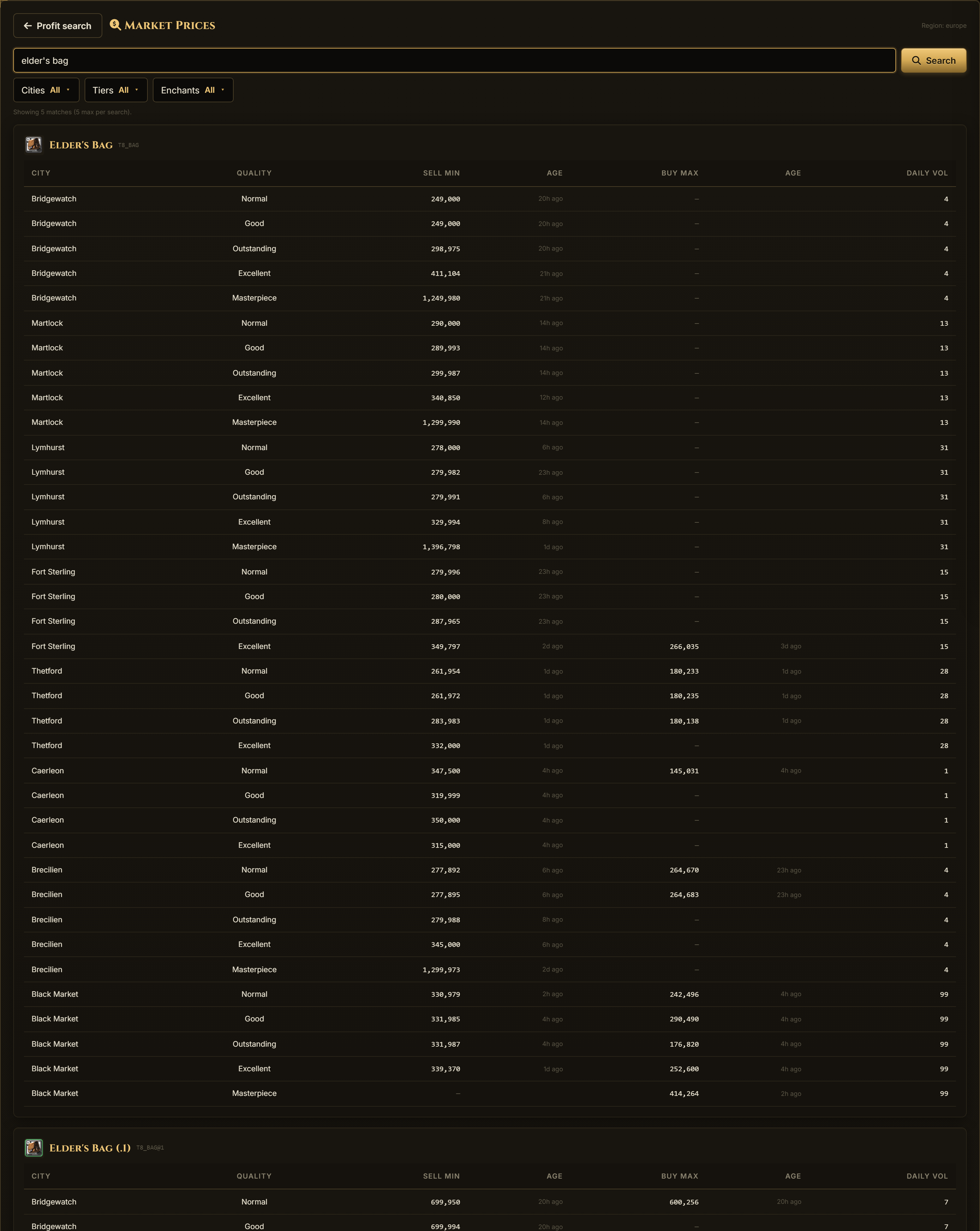
And the part worth stating once, plainly: raw market data in Profit Forge is free, always, the price checker is not paywalled.
Beyond the number: trend and meaning
A current price answers "what now?" but not "is now normal?", for that you want the item's price and volume history: a steady line with regular sales behind it is a market; a lonely spike with no volume is bait. And a price alone never answers the question behind the question: is this worth crafting, hauling or flipping? because that takes taxes, fees, return rates and both cities' books. That is what the calculator tabs are for, and results rebuild from live data every five minutes, so the answer you act on is today's market, not this morning's.
FAQ
How do I check item prices in Albion Online?
In game, the market board only shows the orders of the city you are standing in. To compare cities without traveling, use a community price checker built on Albion Online Data Project scans: search the item once and read each city's lowest sell order and highest buy order side by side: and always check the age shown next to each price before trusting it.
Are Albion Online price sites accurate?
They are exactly as fresh as the community's scans. Prices come from players uploading the order books they browse in game, so a busy market can be minutes old while a rarely visited one shows data from days ago. A trustworthy site displays the age of every price; treat any number without a visible age with suspicion.
What is the Albion Online Data Project?
A donation-funded community project that collects Albion Online market data. Players run a small client that uploads the market orders they browse while playing, and the pooled data is served publicly. Practically every community price tool, including Profit Forge, is built on it.
Is the Profit Forge price checker free?
Yes. Raw market data in Profit Forge is free, always, the Market Prices lookup is never paywalled. Searching an item and reading every city's sell and buy prices, ages and volumes costs nothing.