
Market flipping: buy low here, sell high there
Why Albion Online market flipping works at all
Market flipping in Albion Online is the purest trade in the game: buy a finished item on one city's market, haul it, sell it where it goes for more. No crafting stations, no focus, no Destiny Board grind: capital and a mount are the entire entry ticket. That makes it the most accessible silver in the game, and also the most contested, which raises the obvious question: why do the price gaps exist at all?
Because Albion has no global auction house. Every royal city runs its own player-driven market, and each one's local economy is shaped by its production bonuses, its portal traffic, and what its surrounding zone chain farms. Brecilien, reached through the Mists, prices differently again; so does Caerleon, the hub in the middle of the red zones. And the gaps don't arbitrage away, because closing them means hauling: riding cargo through open-world PvP zones: and most players simply won't. A persistent inter-city price gap is a standing payment offered to whoever will.
What makes a flip real
Three checks separate a flip from a fantasy. First, the margin has to survive tax: the sales tax is 4% with premium, 8% without, and it comes off revenue, not profit, a 10% gross gap without premium is barely a trade. Listing your own sell order also pays a 2.5% setup fee; instant-selling into an existing buy order skips the fee but takes the lower bid price.
Second, both prices have to be real and current. A buy price observed hours ago may belong to a listing that's already gone, and a sell price can be one troll ask nobody will ever pay: a flip computed against either is fiction. This is exactly why serious flippers sanity-check asks against actual trade history and treat the age of every price as part of the math, not a footnote.
Third, volume decides what you actually earn. A 500k margin you can sell twice a day beats a 2M margin with no buyers behind it: the second one isn't income, it's inventory riding around on a mule.
Trade routes and the risk ledger
The routes between cities cross yellow and red zones, and gankers camp the chokepoints because they know exactly what haulers carry. The discipline that keeps flipping profitable is unglamorous: cap each run's cargo value at what you can afford to lose without flinching, ride the fastest mount you own, travel off-peak when the roads are quieter, and write the occasional death into your margins as a cost of doing business. A flipper who loses one run in twenty and priced that in is still rich; one who hauled their whole bankroll "just this once" is a killboard entry.
Be honest about what the margin is: the safest-looking route is priced accordingly, and the routes that pay well pay well because people die on them. The margin IS the danger pay: if you won't carry the risk, the market won't pay you the premium.
Reading a gap: spike or standing pattern
Two gaps can look identical on today's prices and be opposite trades. One is structural: a city that always pays over the odds for an item its locals don't produce, week after week. The other is a one-day spike: somebody bought out the market, the price will settle before your mount is saddled, and you'll arrive holding cargo worth less than you paid. The difference only shows in price and volume history: a standing pattern draws a steady line with regular sales behind it; a spike is a lonely candle with no volume underneath. Checking the chart before committing silver is the cheapest insurance in the trade.
The flips that last: non-craftables, and the NPC buyer
Anything craftable carries a hidden competitor: a local crafter who can make the item on the spot and undercut your hauled stock, that deeper game of margins is its own discipline, covered in the what-to-craft guide. But non-craftable goods: mounts, artifact cape tokens, some furniture: have no such competitor. Nobody in the expensive city can produce them locally, so their inter-city gaps persist far longer than gaps on gear. If you want flips that are still there tomorrow, this is where to look first.
The other special case is the Black Market in Caerleon: an NPC buyer whose orders frequently pay over city prices, making it a flip where the "expensive city" is a vendor that never haggles. It rotates fast and sits behind red zones, and it has its own guide: read Black Market flipping, explained before hauling gear there.
Doing it without spreadsheets
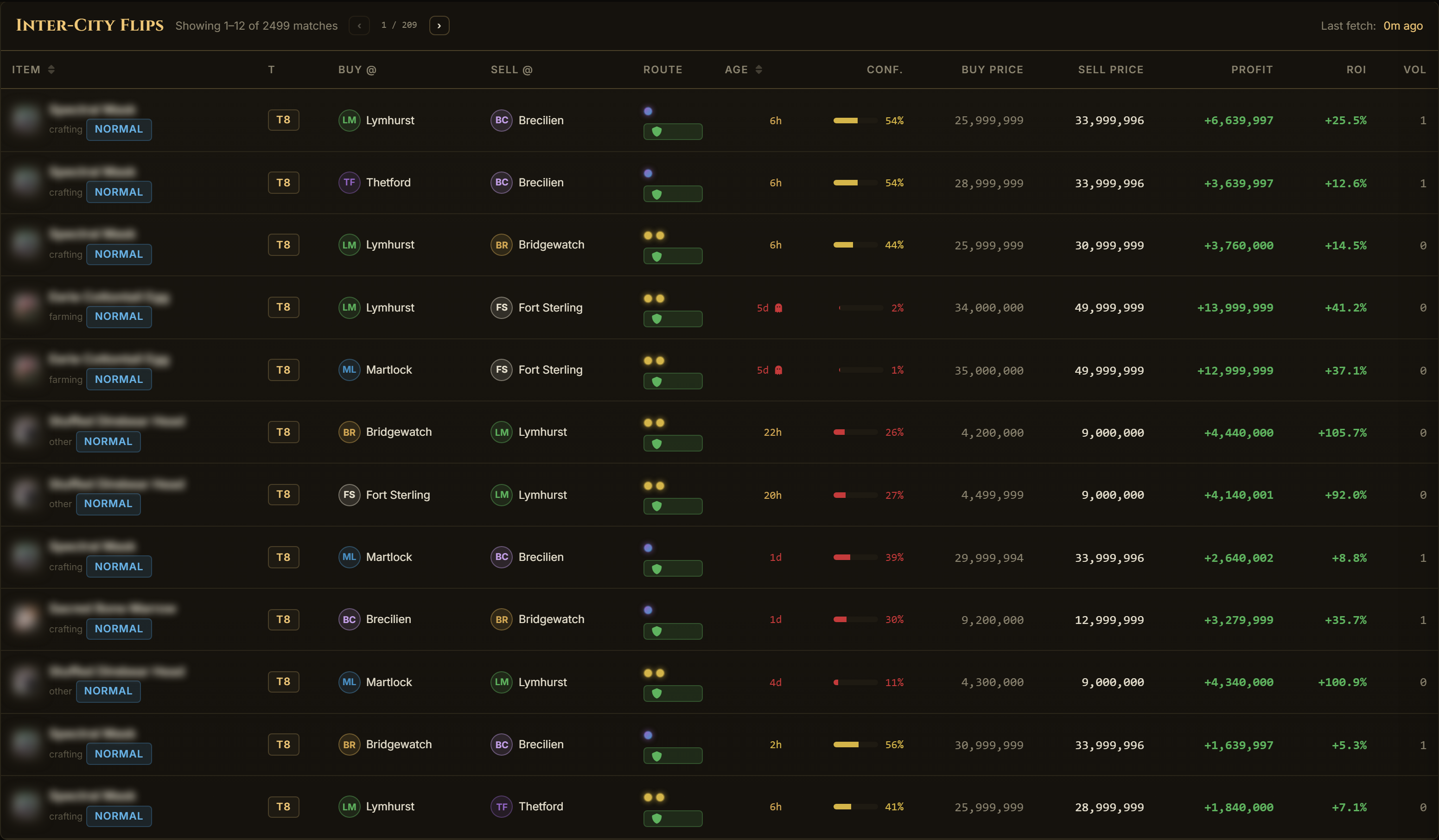
Everything above is arithmetic on live prices, which means it automates. The Non-Craftable tab in Profit Forge scans every pair of cities against every item and lays the answers out sorted by profit: buy city and sell city badges on each row, route safety, ROI, daily volume, and: because a flip needs two honest prices, the age of both sides of the trade, with troll asks anchored against trade history so a bait listing can't invent a margin. The whole table re-sorts itself every five minutes from fresh data (open pages update themselves), so the route on top is the route that pays now, not this morning.
FAQ
How do I make silver flipping items in Albion Online?
Buy a finished item on a city market where it's cheap, haul it to a city where it sells higher, and sell it there. The profit is the price gap minus sales tax: 4% with premium, 8% without, and the hauling risk in between. No crafting, no focus, no Destiny Board progress required: capital and a mount are the whole entry ticket.
What are the best trade routes in Albion Online?
There is no permanent best route. Each city's prices move with its production bonuses, its portal traffic and what its players farm, and any route that pays publicly gets arbitraged flat. The durable answer is a method, not a list: compare current prices for every city pair, subtract tax, verify both prices are fresh and backed by real volume, and re-check today.
Is market flipping safe in Albion Online?
Not entirely: the routes between cities cross open-world PvP zones, and the profitable ones are profitable precisely because of that risk. Cap each run's cargo value at what you can afford to lose, ride a fast mount, travel off-peak, and budget the occasional loss into your margins instead of pretending it won't happen.
Do I need premium to flip items in Albion Online?
No, but it helps more than it looks. Premium halves the sales tax from 8% to 4%, and the tax comes off revenue, not profit, so on the thin margins flipping usually runs, that difference alone can decide whether a route pays at all.