
Refining profit: the quietest silver in the game
What refining in Albion Online actually is
Every piece of gear in Albion Online starts as a raw resource somebody refined: ore into metal bars, hides into leather, fiber into cloth, wood into planks, stone into blocks. Whether that conversion makes silver: the Albion Online refining profit question: has a genuinely unintuitive answer, because the recipe is more than "raw in, refined out." Each refine of tier N consumes raw resources of tier N plus a refined material of the tier below as a catalyst. T4 bars need T3 bars; T5 bars need T4 bars; and so on up the ladder.
That catalyst chain means refined prices compound up the tiers: every inefficiency at T4 is baked into the cost of T5, and again into T6. It also means a refiner is always a buyer of their own product one tier down: which is why the market for refined materials never sleeps, and why small percentage edges multiply into real money for people who refine at scale.
The return rate is the business
Every refine returns a share of its materials back to you, and that share: the resource return rate, is the entire economics of refining. In a royal city with no bonus, the base rate is roughly 15%. Each royal city holds a production bonus for one resource line, and refining that line in its bonus city pushes the rate to around 24% or more. Spend focus on the craft and it climbs past 40%: nearly half your inputs handed back per action.
This is why the same conversion can lose silver for one player and print it for another on the same day, at the same prices. At a 15% return, the refined material often sells for less than the raws, catalyst and fees that went into it. At focused bonus-city rates, the effective cost of inputs drops by a quarter or more, and the identical conversion clears a healthy margin. Dedicated refiners aren't finding secret prices: they're running the same math with a better return rate in it.
The real cost sheet
A refine's profit is one line of arithmetic, and every term matters: refined sell price × (1 − tax) − raw cost − catalyst cost − station fee + value of returned materials. The sales tax is 4% with premium, 8% without, and it comes off revenue, not profit, brutal on margins this thin. The station charges a usage fee per action. The catalyst is a real cost even though it isn't the headline ingredient. And the returned materials are real revenue, scaled by your return rate, leaving them out of the math understates every refine.
The most expensive mistake in refining, though, is the input that feels free. "I gathered this ore myself, so refining it is pure profit" ignores that the raw ore has a market price you are forgoing by not selling it: an opportunity cost, and it's just as real as silver leaving your pocket. Refining adds value only when the refined material sells for more than the raws plus every fee in the line above. When it doesn't, the correct play is to sell your gathered resources raw and keep the difference.
Plainly: "always refine your own resources" is bad advice, and so is "always sell raw." The answer flips item by item and week by week with the prices: anyone giving you a permanent rule isn't doing the math.
Three cities, three decisions
Raw resource prices differ per city, each market is fed by the zones around it and drained by its local industry. So a refining operation is really three separate decisions: where to buy the raws (wherever they're cheapest), where to refine (the bonus city for your line, almost always), and where to sell the refined material (wherever crafters pay most). Collapsing all three into "my home city" is convenient, and it quietly donates the margin to whoever doesn't.
The gap between the lazy version and the three-city version is often the entire profit. Buying raws where gatherers dump them, hauling to the bonus city, and selling bars into a crafting hub is the refining trade at full strength, the same cross-city sourcing logic covered in cross-city shopping, and the hauling legs carry the same risk discipline as any trade route: cap the cargo, ride fast, price the occasional loss in.
Thin and steady beats fat and fake
Refined materials are the commodities of Albion's economy: every crafter needs them constantly, so they trade in volume all day, every day. That makes refining steadier than gear speculation; you will rarely be stuck holding stock nobody wants, the way a crafter can be with an unfashionable weapon. The price of that steadiness is thin margins per unit: refining is a volume business, and precision on fees, tax and return rate decides everything.
Thin margins also mean stale or bait prices are fatal rather than merely annoying. A margin computed against a troll ask nobody will pay, or a raw price observed yesterday, isn't a thin profit, it's a loss wearing makeup. Serious refiners sanity-check sell prices against actual trade history and treat the age of every price in the math as part of the calculation, not a footnote.
Doing it without spreadsheets
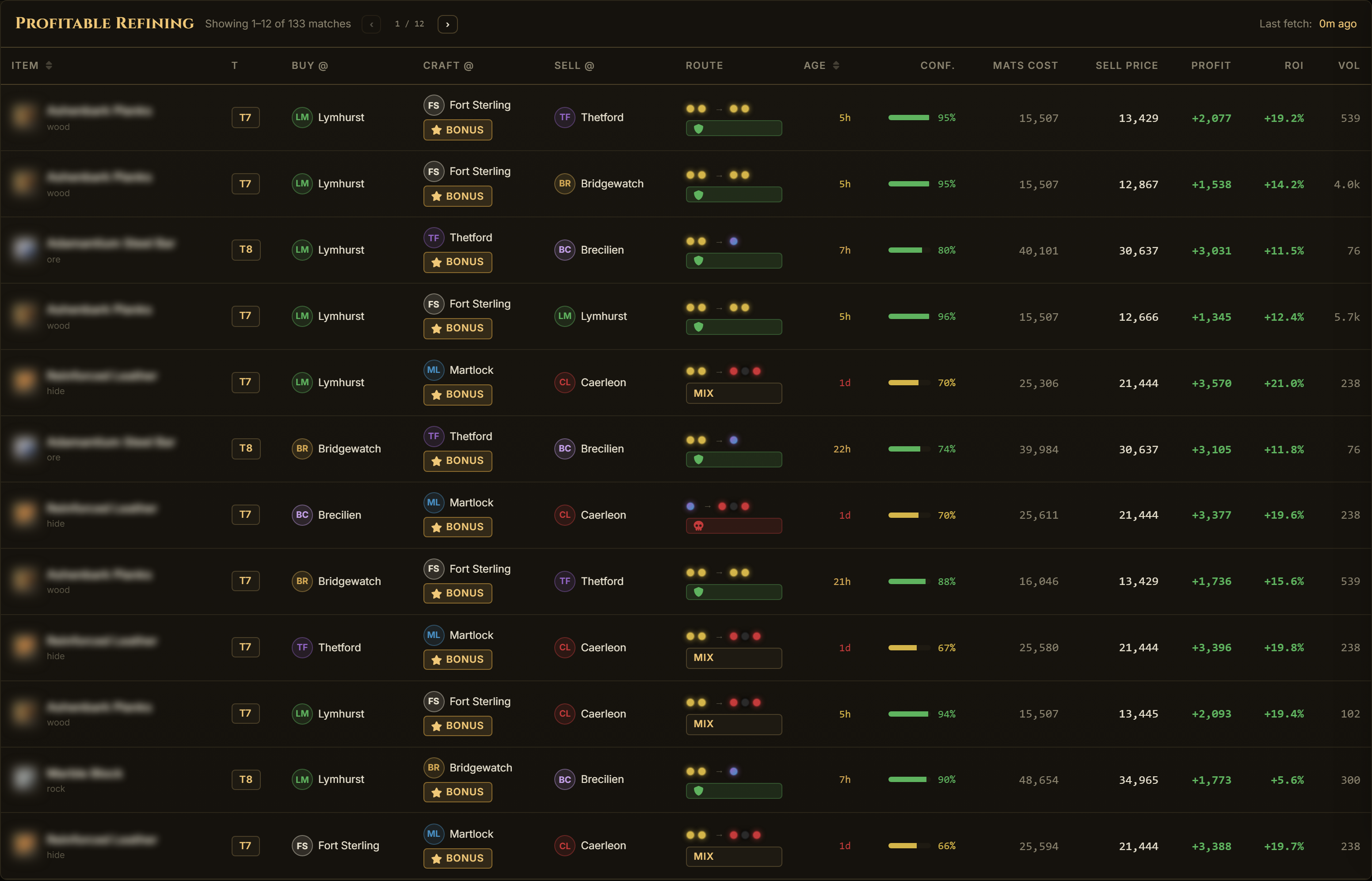
Everything above is arithmetic on live prices, which means it automates. The Refining tab in Profit Forge prices every raw-to-refined conversion across every tier and city and lays the answers out sorted by profit: buy, refine and sell city badges per row, your return rate and premium status applied, catalyst and station fee in the math, with cost against sell price, ROI, daily volume, the age of every price used, and a confidence score, troll asks anchored against trade history so a bait listing can't invent a margin. The table rebuilds itself every five minutes from fresh data, so the conversion on top is the one that pays now, not this morning.
FAQ
Is refining profitable in Albion Online?
Usually yes: if you refine in the city with the production bonus for your resource line, and especially with focus. The higher return rates turn conversions that lose silver at the roughly 15% base rate into profitable ones. At base rates, many conversions lose money once fees and taxes are counted, so check the math on live prices before committing.
Should I refine my own gathered resources or sell them raw?
Only when refining adds value. Gathered resources are not free: they have a market price you give up by refining them instead of selling them. Compare what the raws would sell for against the refined material's price after tax, minus the catalyst cost and station fee, plus the value of returned materials. Sometimes selling raw is the better trade.
Where should I refine in Albion Online?
In the royal city that holds the production bonus for your resource line: each city specializes in one. The bonus lifts the return rate from roughly 15% to around 24% or more, which is frequently the whole difference between profit and loss. Where you buy your raws and where you sell the refined material can still be different cities.
Do I need premium or focus to profit from refining?
Not strictly, but both stack the math in your favor. Premium halves the sales tax from 8% to 4%, and focus pushes return rates past 40%. Refining margins are thin per unit, so those percentage points often decide whether a conversion pays at all.