
Albion Online transmutation: the tier-ladder trade
What transmutation is
Albion Online transmutation is the simplest conversion in the game: hand over an item and a silver fee, receive the same item one tier higher. No materials, no crafting station, no Destiny Board requirement, the fee is the whole recipe. Three item families work this way: artifact reagents (the rune, soul and relic lines), royal sigils, and dungeon maps. A stack of T5 runes becomes T6 runes; a T6 map becomes a T7 map; the only question is whether the fee was worth paying.
That question has a precise answer, because every one of these families already has a market price at every tier. Transmutation is therefore not a production business, it's a trade against the market's own pricing of its tier ladder, and it pays exactly when that ladder is priced wrong.
The tier-ladder arbitrage
Picture a family's prices as a ladder: T4 runes at one price, T5 above it, T6 above that. In an efficient market each rung would sit just far enough above the last that paying the transmute fee gains you nothing: anyone could do the conversion, so any gap should get arbitraged away. And mostly, it is. But the ladder drifts, and it drifts for a structural reason: demand concentrates on specific tiers while supply arrives at random ones. Players buy the reagent tier their target artifact needs and the map tier their group actually runs: whatever content is popular this month decides which rung gets bought. Supply, meanwhile, is loot: players sell whatever tier happened to drop, with no regard for which rung anyone wants.
So a popular tier's price climbs while the tier below it, looted just as often, wanted less: sags. When the gap between two rungs stretches past the transmute fee plus the sales tax on your sale, the conversion prints silver: buy the sagging rung, pay the fee, sell the expensive one. When the ladder snaps back into line, that rung stops paying: and some other family's ladder, somewhere, has started to sag instead.
The three-number math
If you've read a crafting cost sheet, transmutation's will feel almost suspiciously short. A craft's margin runs through material baskets, return rates, city production bonuses, focus, station fees and batch yields before it reaches a number. A transmute has three numbers: the input item's price, the fixed silver fee, and the output's sale price, minus the usual sales tax of 4% with premium or 8% without. That's the entire model. No returns to estimate, no focus to budget, no station bonus to chase across cities.
The fee itself is set by the game and scales with the conversion, pushing a reagent into the top tiers costs dramatically more than nudging a T4 to T5: but for any given rung it's a constant. That makes transmutation the purest "spot the mispriced rung" trade Albion offers: two market prices and a known constant between them. Either the gap clears the fee and tax, or it doesn't. The skill isn't in the arithmetic: it's in checking enough rungs, often enough, to be there when one drifts.
One reagent, three exits
Artifact reagents complicate the picture in a profitable way, because transmutation isn't their only door. The same rune, soul or relic can be sold raw on the market, melded into an artifact at the Artifact Foundry, or transmuted up a tier, after which the higher-tier version faces the same three choices. One input, three exits, and the best one changes with prices: a T5 soul might be worth more melded this week and more transmuted-then-sold next week, purely on how the reagent and artifact markets have moved.
Melding is its own expected-value game, reagent cost against a weighted pool of artifact outcomes, covered in the artifact melding guide and documented in the melding section of the full guide. What matters here is that a reagent sitting in your bank isn't "a thing to meld" or "a thing to sell", it's an option on all three routes, and pricing only one of them means routinely taking the wrong exit.
The thin-market discipline
Here's the catch that separates the scanner from the mark: sigils and maps: and the higher reagent tiers, trade thin. Listings sit for days. A handful of sales can be the whole day's volume. In a market that thin, the cheapest visible ask is not automatically "the price": one optimistic listing on the output side can fake an entire rung's profitability, because the number you're planning to sell at is a number nobody has actually paid. Anchoring revenue to what trades have really cleared, the idea behind realistic revenue, matters more in transmutation than almost anywhere else.
Freshness is the same story. A rung computed from a price nobody has confirmed since yesterday is a hypothesis, not a margin, knowing how old each price is decides whether a gap is live or archaeological.
Plainly: a rung that has looked mispriced for a week isn't an opportunity: it's a price nobody will actually pay. Real ladder gaps get closed by people like you; the ones that persist are telling you the listed price is fiction.
Doing it without spreadsheets
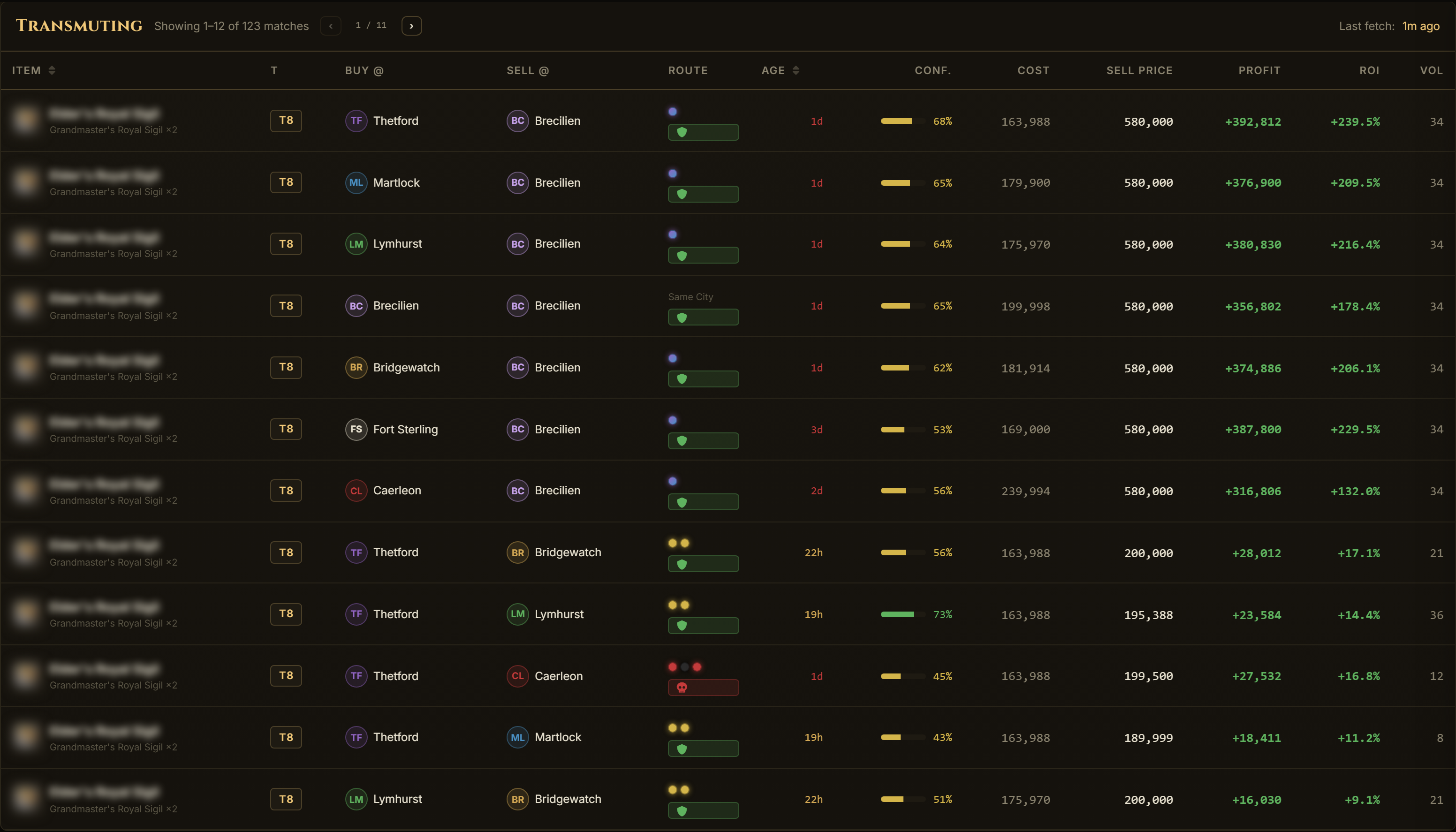
Everything above is three-number arithmetic repeated across every rung of every ladder: reagents, sigils and maps, tier by tier, and re-asked whenever any price moves. Which means it automates. The Profit Forge transmute tab prices every tier-up conversion live: input cost plus the silver fee against the output's market price, tax included, sorted by profit so the currently mispriced rungs, if any, surface at the top. Each row carries the age of the stalest price in its math, a confidence score, ROI and the traded volume that says whether the output price is real, so a week-old fantasy rung can't masquerade as a trade. The full guide's transmute section documents exactly how each rung's number is built.
FAQ
What can you transmute in Albion Online?
Three item families convert up a tier for a silver fee: artifact reagents (rune, soul, relic lines), royal sigils, and dungeon maps. You pay the fee, hand over the lower-tier item, and receive the next tier of the same item: no materials, stations or crafting skill involved.
Is transmutation profitable in Albion Online?
Only when a specific conversion is mispriced, when the higher tier sells for more than the lower tier's price plus the fee and sales tax. Most conversions, most of the time, are priced efficiently. Profit comes from checking many tier ladders often and catching the rungs that have drifted, not from grinding one conversion forever.
How much does transmutation cost?
A fixed silver fee per conversion, set by the game and scaling with the specific conversion: higher tiers cost more to reach. There are no material costs and no return rates: the fee plus the input item's price is the entire cost side. Check the exact fee in-game or against live prices before committing.
Should I transmute my artifact reagents or meld them?
Neither, always: a reagent has three exits: sell it raw, meld it into an artifact, or transmute it up a tier and then sell or meld the higher version. Which exit pays best changes with live prices on all three routes, so price them against each other before choosing rather than defaulting to one.