
Artifact melding: the gamble you can price
What Albion Online artifact melding actually is
Albion Online artifact melding is a simple transaction with a random ending: carry 50 identical artifact reagents, Runes, Souls, Relics or Avalonian Shards of one tier, to the Artifact Foundry, and it melds them into one random artifact from that tier's loot pool. The Foundry stands in every royal city and, unlike refining or crafting stations, no city holds a melding bonus. Where you meld changes nothing; what you feed in and what the pool contains decides everything.
Reagents pile up naturally: salvaging the gear that dungeons and chests shower on you breaks it down into exactly these fragments. Which is why almost everyone eventually stands in front of the Foundry with a few hundred Runes asking the same question, meld these, or sell them?
A gamble, not a craft
A craft has a known output. A meld has a distribution: the result is a uniform random draw from the tier's pool, so in a pool of 28 artifacts every one of them lands with the same roughly 3.6% chance. A couple of those outcomes are jackpots, sought-after artifacts worth millions because a meta build eats them. Many more are duds that sell for less than the 50 reagents you burned. The Foundry doesn't care which you wanted.
That shape is what trips people. Hype travels on the jackpot ("melded Runes, pulled a big one, got rich"), and players start valuing the pool by its best outcome: jackpot-anchoring. But a ~3.6% outcome means about 27 of every 28 melds hand you something else, and the something-else is what actually determines whether melding pays.
Plainly: a pool valued by its best outcome is a lottery ad, not a valuation. If a meld pitch only mentions the most expensive artifact in the pool, it isn't math: it's marketing.
The honest math: expected value
The only honest way to price a random draw is expected value: walk the entire pool and sum each artifact's drop chance times its sell price. That weighted sum is the expected sell: what one meld is worth on average, jackpots and duds both pulling their real weight. Then the profit line reads: EV sell × (1 − tax) − 50 × reagent price, with the sales tax at 4% with premium and 8% without, taken off revenue as always.
Two details make or break the calculation. First, the whole pool means the whole pool: an artifact nobody is buying, or one with no market listing at all, still keeps its slice of probability, it just contributes nothing to the sum, dragging the expected value down. Skipping unsellable outcomes silently inflates every meld. Second, reagent price is a live number: reagents spike when a patch makes some artifact fashionable, and a spike on the input side eats a margin that looked comfortable last week.
The 20-meld batch test
Expected value is an average, not a promise. A single meld with positive EV can still lose: most single melds miss the outcomes that carry the average. The question that matters to a person actually feeding reagents into the Foundry is: how often does the average show up?
The useful framing is a batch. Over 20 melds, the spread of results tightens around the expected value, and the variance math can state something concrete: the chance that a 20-meld batch ends profitable. Two pools can both show positive EV and behave completely differently, one leans on a rare jackpot and profits maybe six batches in ten, another spreads its value across many decent outcomes and clears 90%+. Same "profitable on paper," very different businesses. That batch number: not the best-case artifact: is the line between gambling and trading.
Where each artifact sells
Melding location doesn't matter; selling location matters enormously. Each artifact feeds different builds, and demand for those builds differs by city: so every outcome in the pool has its own best market. Pricing all 28 outcomes in one city, because that's where you happen to stand, misprices the pool: some artifacts get overvalued, most get undervalued, and the EV you computed isn't the EV you'll realize. Priced each at its own best city, the same pool can swing from a paper loss to a genuine margin.
Artifact markets are also thin. These aren't commodities that trade by the stack every hour: a listing can sit for days, so the price you scrape may belong to an order long gone, and a single troll listing can distort an outcome's value. Thin markets are exactly where the age of every price stops being a footnote and becomes part of the math, where sanity-checking asks against actual trade history keeps one bait listing from inventing a jackpot, and where a quick look at an artifact's price and volume history tells you whether anyone really buys at the number on screen.
Sell the reagents, or meld them?
The last trap is the input that feels free. Reagents arrive as a by-product of playing, so melding them feels like conjuring silver from nothing. It isn't: 50 Runes have a market price, and melding them means spending that price on a lottery ticket. The honest comparison is always the raw sale versus the pool's expected value after tax: the same opportunity-cost logic that decides whether to refine raw resources or sell them. When reagents are expensive and the pool is weak, selling raw wins outright, with zero variance. When the pool's EV clears the reagent cost with a strong batch chance behind it, melding is the better trade: and now it's a calculated one.
Doing it without spreadsheets
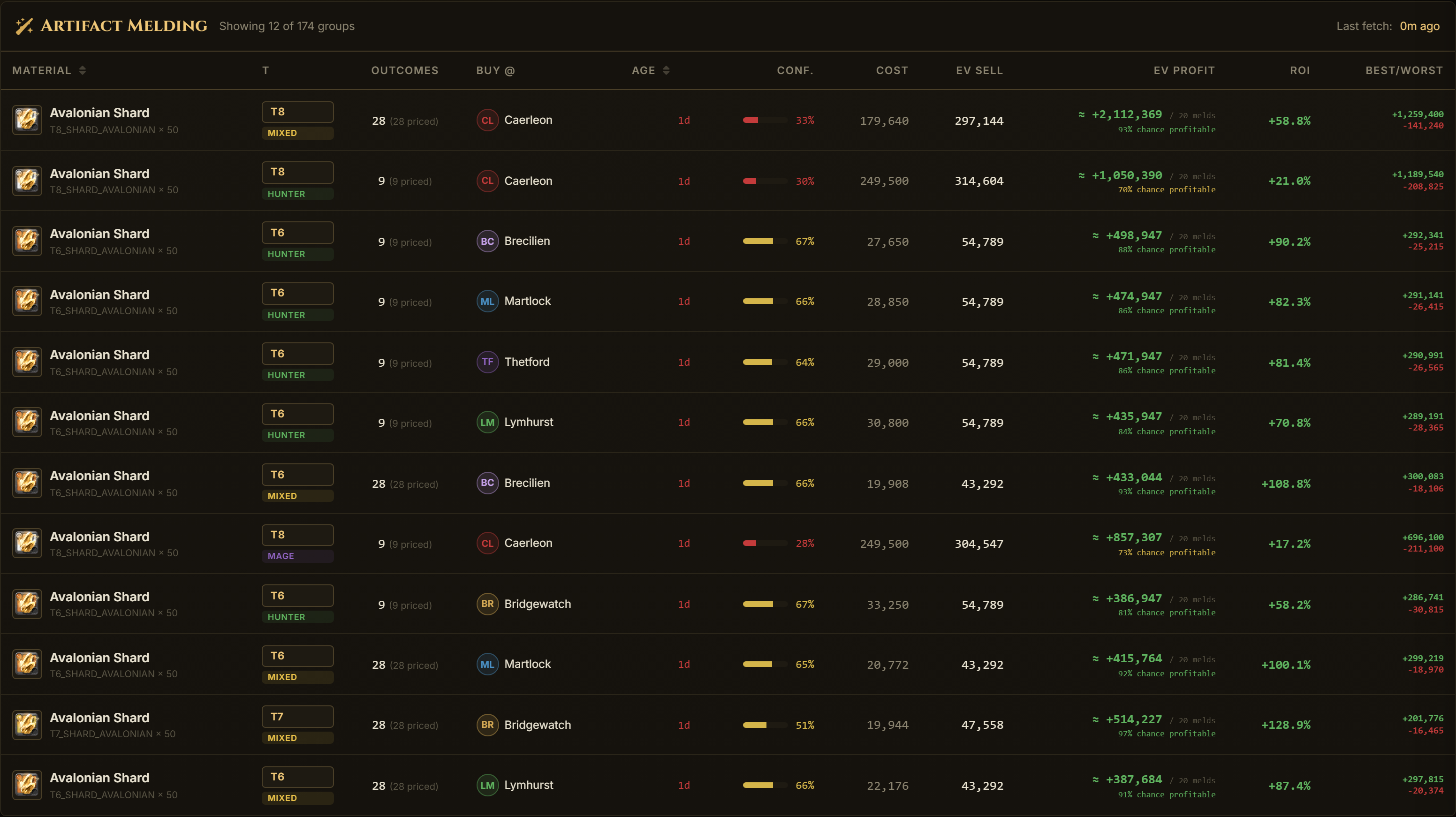
Everything above is arithmetic on live prices across dozens of outcomes and cities: which means it automates. The Melding tab in Profit Forge runs the full expected-value model the guide documents: one row per reagent, tier and buy city, with EV profit, ROI, the projected silver per 20 melds alongside the chance that batch ends profitable, the best and worst outcome in the pool, and the confidence and effective age of the data underneath: refreshed every five minutes.
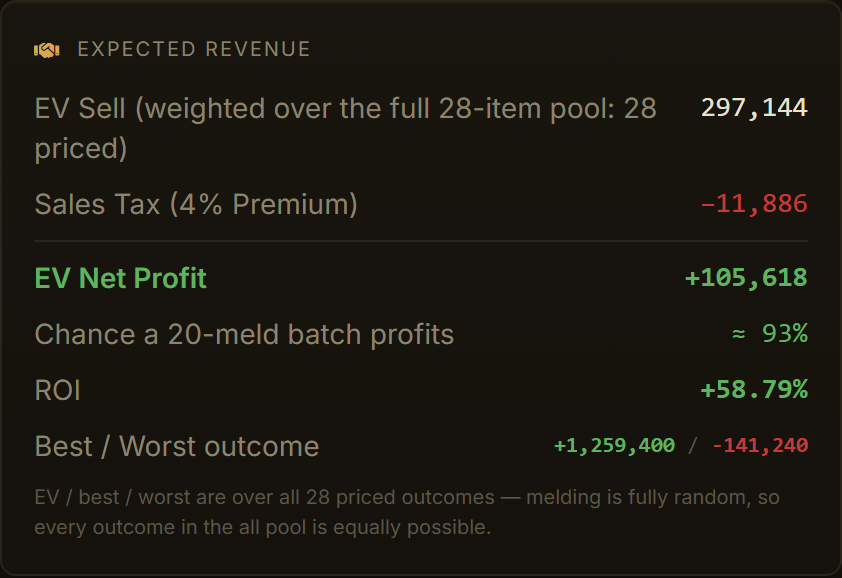
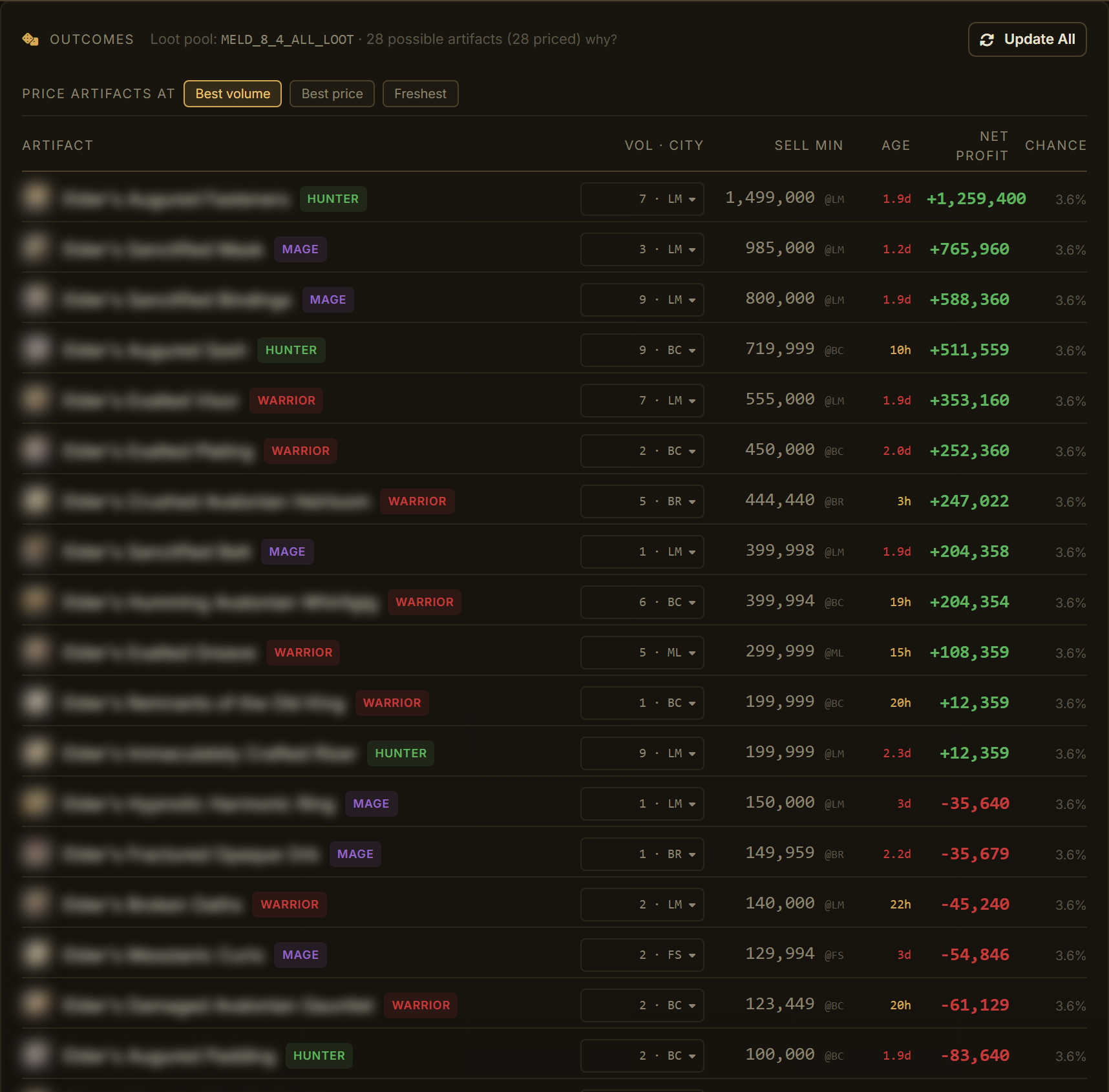
Open a row and the Expected Revenue card shows the weighted math itself: probability-weighted EV sell, tax, EV net profit, the 20-meld batch chance: while the Outcomes card lists every artifact in the pool with its drop chance, each priced at its own best city under the strategy you pick (best volume, best price, or freshest data), with sold volume, price age and net profit per outcome. The unsellable duds sit right there at zero, dragging the EV down where you can see them doing it.
FAQ
Is artifact melding worth it in Albion Online?
Only when the expected value of the whole loot pool beats the cost of the 50 reagents after tax: and that flips week to week as reagent and artifact prices move. Value every outcome by its drop chance and sell price, not by the best artifact in the pool. Some reagent-tier combinations are reliably profitable, many quietly lose silver.
Where is the Artifact Foundry in Albion Online?
In every royal city: and unlike refining or crafting stations, no city gives a melding bonus. Where you meld doesn't change the result or the odds, so meld wherever your reagents already are. What does differ by city is where each artifact outcome sells best.
What are the odds of getting a specific artifact from melding?
The meld result is a uniform random draw from the tier's loot pool, so the chance of any specific artifact is one divided by the pool size. In a 28-artifact pool that's roughly 3.6% per meld, meaning around 27 of every 28 melds give you something other than the artifact you were hoping for.
Should I sell my artifact reagents or meld them?
Compare the two numbers: what 50 reagents sell for raw on the market, versus the pool's expected sell value after tax. Reagents from salvaging aren't free: they have a market price you give up by melding. When the raw sale beats the expected value, selling is the better trade, exactly like selling raw resources instead of refining them at a loss.